liveBook · Manning

Projection layer

As explained in Retrieval Augmented Generation, The Foundational Ideas

A projection layer is the intermediate layer of a Word2Vec network whose rows serve as learned word-vector representations.

A projection layer is the intermediate layer in a Word2Vec network whose rows become learned word vectors. Training uses these vectors to predict context or center words from raw text; after training, the layer is discarded and the dense embedding matrix remains. CBOW sums context-word embeddings for efficient prediction, while Skip-gram predicts surrounding words independently and often captures stronger relationships for infrequent terms. section 2.1.2

Figure 2.1 CBOW vs skip-gram architectures.
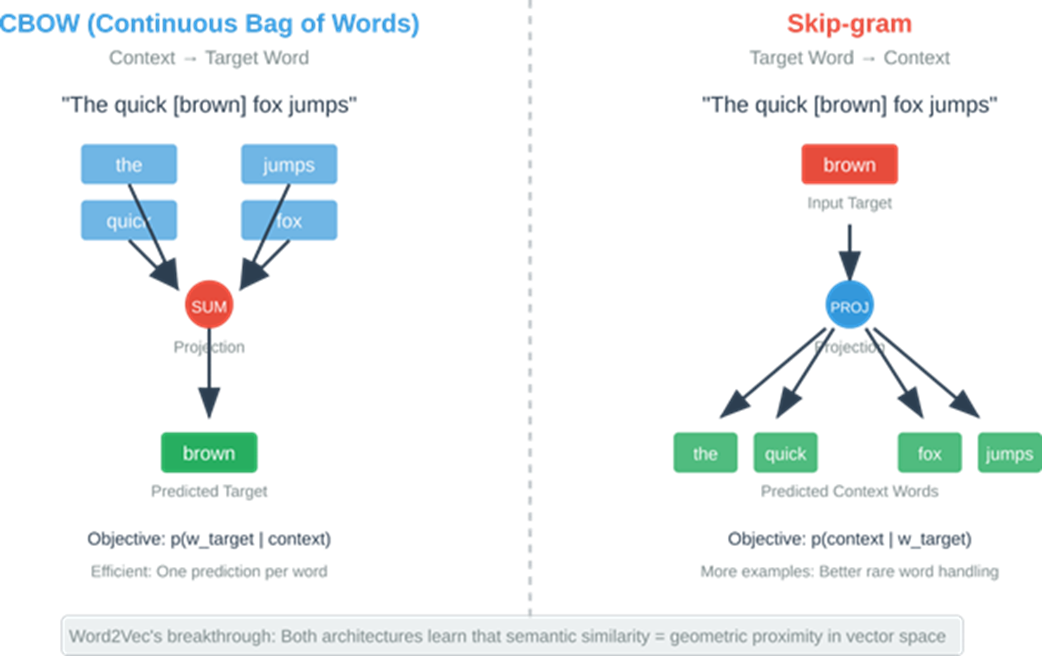
Compare how CBOW and Skip-gram route words through the projection layer before producing predictions. section 2.1.2

How Retrieval Augmented Generation, The Foundational Ideas covers it

How deep it goes
Explains the layer’s output, disposal after training, and CBOW versus Skip-gram behavior without detailing optimization internals.
Examples
Uses CBOW’s summed context embeddings, Skip-gram’s independent context predictions, and word-vector analogy arithmetic.
What you can do after
Evaluate CBOW and Skip-gram tradeoffs and interpret the resulting dense matrix as word representations.
How it connects
Connects Word2Vec with embeddings, self-supervised learning, CBOW, Skip-gram, and context-window prediction.

Related concepts

This explainer was generated by Manning's knowledge graph from the text of Retrieval Augmented Generation, The Foundational Ideas. The section links point to the parts of the book it draws on.