liveBook · Manning

Promiscuous compound

As explained in Build AI Drug Discovery Pipelines

Off-target promiscuity is the tendency of a compound to inhibit or modulate multiple unintended biological targets.

Off-target promiscuity is a compound’s tendency to inhibit or modulate multiple unintended biological targets. For kinase inhibitors, this creates a practical drug-discovery problem: success requires both strong affinity for the intended protein and selectivity across the broader kinase family. section 8.1.1

Kinases commonly bind inhibitors at the highly conserved ATP-binding site, making specificity difficult to establish experimentally across all kinases. Computational methods provide a more tractable way to investigate this selectivity problem than routine exhaustive testing. section 8.1.1

Figure 8.2 Map of human protein kinases, i.e., the Manning kinome tree, clustered based on sequence similarity into eight major groups [3].
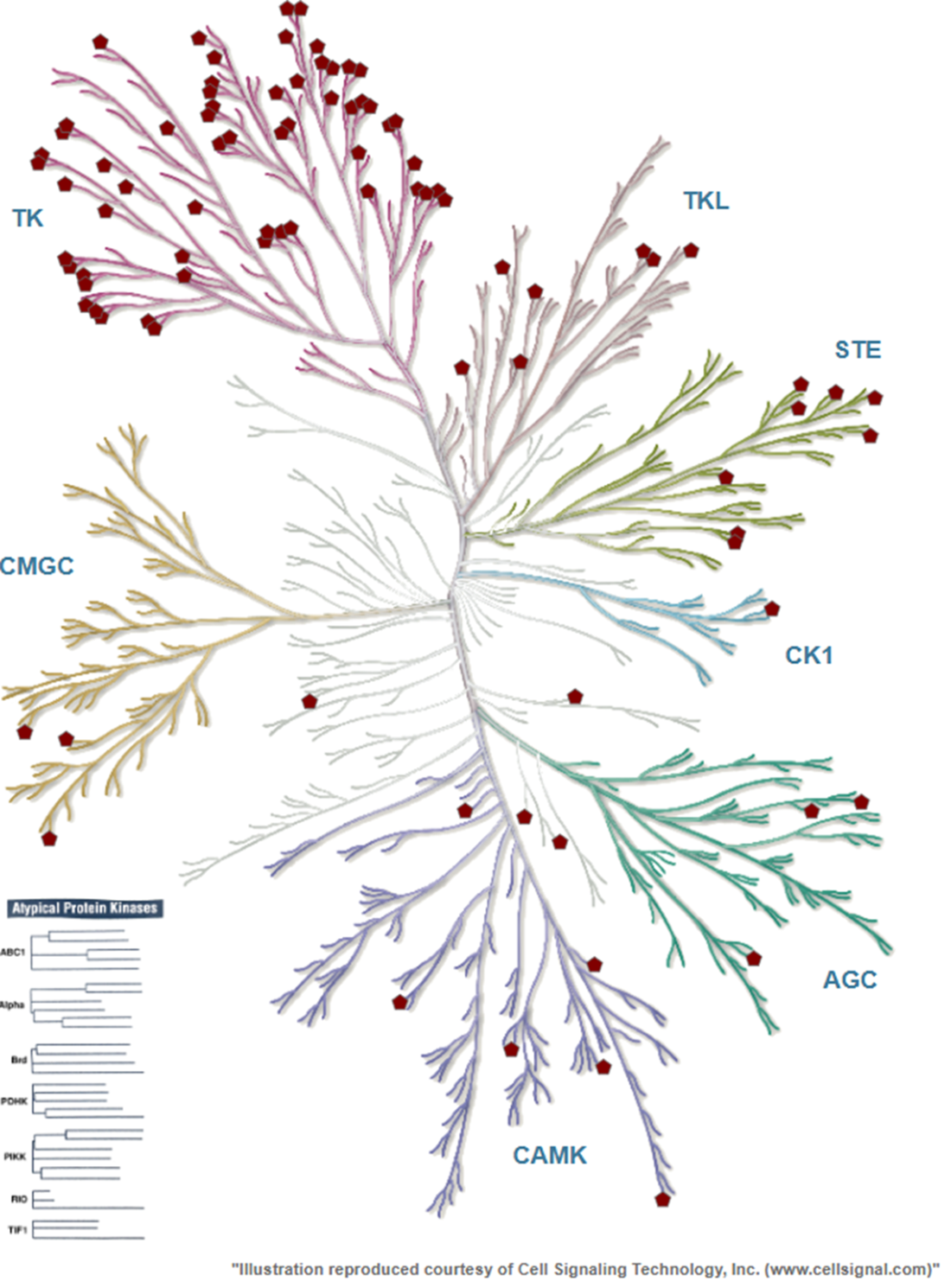
Use the human kinome map to place kinase targets within sequence-similarity groups and frame the breadth of possible off-target interactions. section 8.1.1

How Build AI Drug Discovery Pipelines covers it

How deep it goes
Defines the phenomenon and explains its ATP-site and testing-cost rationale, but stops short of specifying a computational method.
Examples
Uses kinase inhibitors, the conserved ATP-binding site, and the human kinome as concrete examples.
What you can do after
Evaluate why computational methods can support kinase-selectivity analysis when routine testing across all kinases is prohibitively expensive.
How it connects
Connects off-target promiscuity with kinase inhibitors, protein kinases, drug affinity, selectivity, and ATP-binding sites.

Related concepts

This explainer was generated by Manning's knowledge graph from the text of Build AI Drug Discovery Pipelines. The section links point to the parts of the book it draws on.