A prompt pattern is a reusable strategy for addressing a recurring language-model task. It shapes how the model approaches the task—such as generating, critiquing, or adapting—rather than merely formatting the prompt. section 4.1
Eight patterns are grouped by the role they play:
- Structural patterns—role assignment, delimiter, template, and repetition—guide task approach and consistency. section 4.1
- Contextual patterns—self-reflection and inversion—surface insights, outside perspectives, and blind spots. section 4.1
- Transformational patterns—refinement and comment-driven generation—improve existing content using analysis. section 4.1
Figure 4.1 Prompt pattern taxonomy showing structural, contextual, and transformational patterns
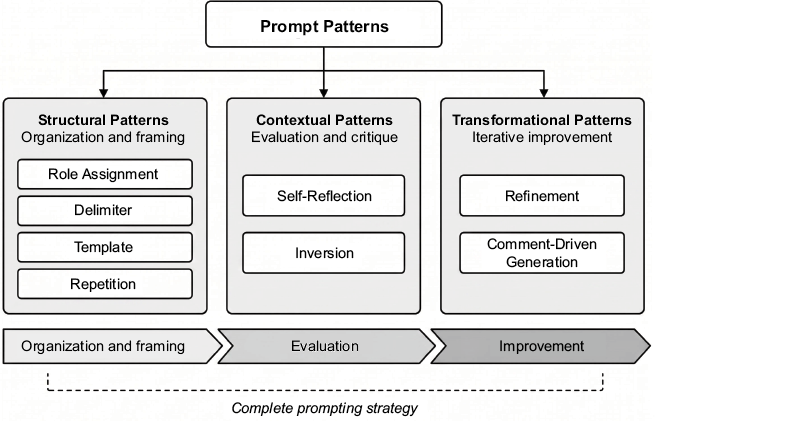
Use the taxonomy to distinguish patterns that establish task structure from those that surface gaps or improve existing content. section 4.1
Feature-planning prompt
Act as a senior software engineer. Create an implementation plan for {{feature_name}} using {{business_goal}}, {{acceptance_criteria}}, {{constraints}}, and {{target_release}}. Follow the specified output format and scope constraints. section 5.2.1
