liveBook · Manning

Proof of concept

As explained in Think Like a CTO

A proof of concept is a limited implementation or demonstration used to test whether a proposed solution is technically feasible or suitable.

A proof of concept is a limited implementation or demonstration used to test whether a proposed solution meets practical requirements before committing to it. In technology buying, it narrows evaluation to leading candidates rather than replacing broader due diligence. section 8.2.1 section 8.8.2

Use a proof of concept as a focused decision aid:

  • List requirements and classify each as must-have or nice-to-have before testing solutions. section 8.2.1
  • Run focused proofs of concept against the final two candidates to keep the work useful and bounded. section 8.2.1
  • Ask a vendor to build the demonstration when the purchase is substantial; treat this as part of the technical sale. section 8.2.1
  • Do not select the technology solely because it powered the proof of concept; confirm that it can scale into production. section 8.8.2

A vendor-built demonstration

A large software purchase can include vendor engineers building a proof of concept, much like a test drive helps assess a car before purchase. The demonstration tests fit, but the final decision must also consider lock-in, feature limits, support, and the vendor’s release schedule. section 8.2.1

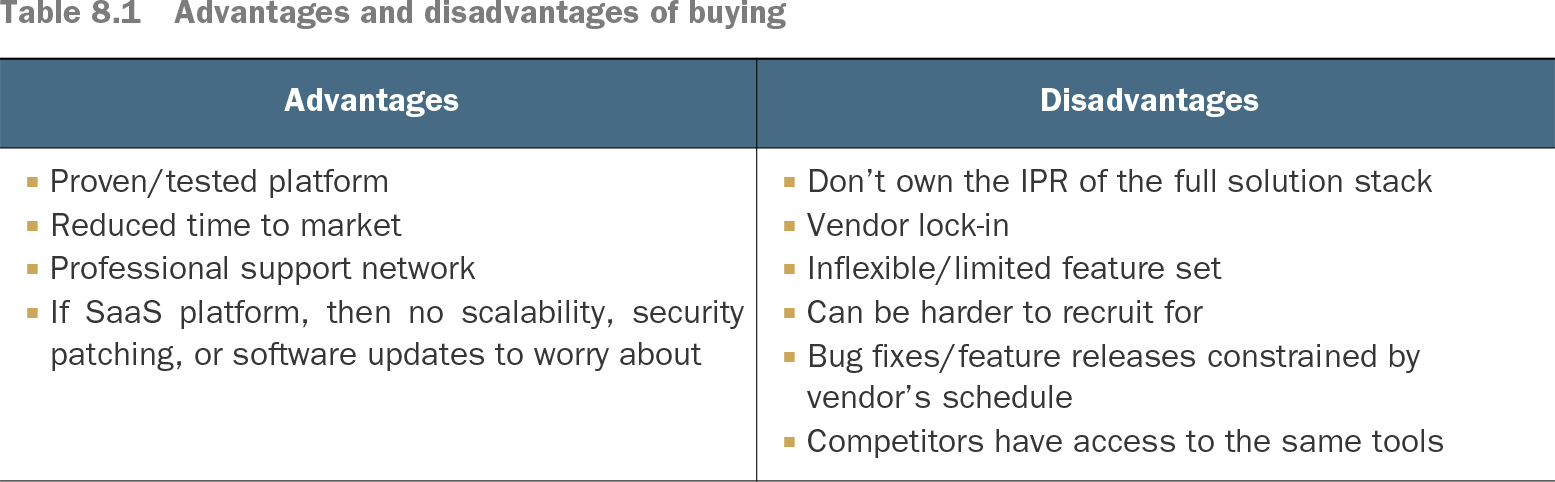
Table 8.1 Advantages and disadvantages of buying (view table figure)

Advantages

Disadvantages

  • Proven/tested platform

  • Reduced time to market

  • Professional support network

  • If SaaS platform, then no scalability, security patching, or software updates to worry about

  • Don’t own the IPR of the full solution stack

  • Vendor lock-in

  • Inflexible/limited feature set

  • Can be harder to recruit for

  • Bug fixes/feature releases constrained by vendor’s schedule

  • Competitors have access to the same tools

Compare the broader advantages and disadvantages surrounding a purchased solution before treating a successful proof of concept as sufficient evidence. section 8.2.1

How Think Like a CTO covers it

How deep it goes
Defines requirement-driven testing and vendor participation, but stops short of specifying implementation methods or formal acceptance criteria.
Examples
Uses must-have lists, two-candidate evaluations, vendor-built demonstrations, and a test-drive analogy.
What you can do after
Evaluate competing solutions against explicit requirements without mistaking a successful prototype for production readiness.
How it connects
Connects proof of concept with software procurement, vendor selection, productionization, scalability, and vendor lock-in.

Related concepts

This explainer was generated by Manning's knowledge graph from the text of Think Like a CTO. The section links point to the parts of the book it draws on.