A proof-of-concept device demonstrates that quantum-mechanical principles can perform a computation. It establishes practical experimentation beyond theoretical conjecture, but need not solve a useful problem. section 1.3.2
The milestone was achieved by early nuclear magnetic resonance quantum computers running small algorithms such as Deutsch, Deutsch–Jozsa, and Grover’s search. Such devices remain too small and noisy for practical problems. section 1.3.2
Figure 1.2 The major milestones of quantum hardware development. The first two, showing the use of quantum mechanics to perform a computation and having a quantum computer solve an artificial problem that a classical computer cannot, have already been achieved. The next milestone, building a fault-tolerant quantum computer that can run long computations, is the current focus. The final goal is to build a quantum computer that can solve practical problems that a classical computer cannot.
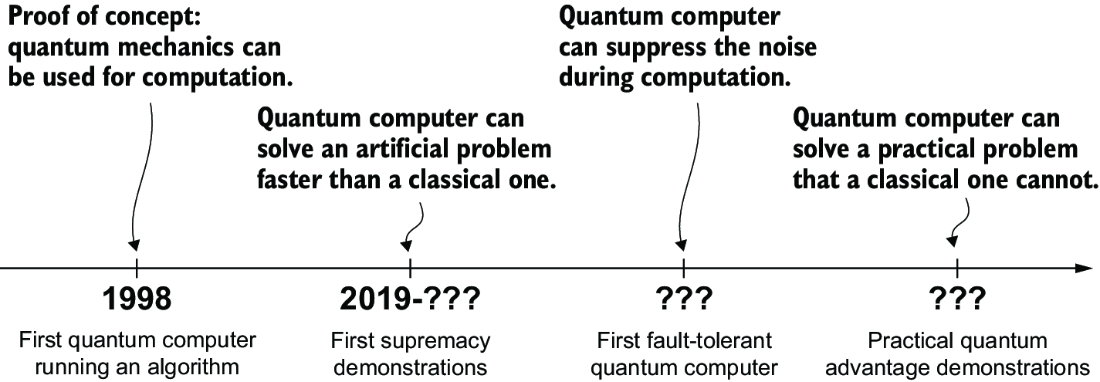
The hardware-development milestones place proof-of-concept computation before artificial-problem demonstrations, fault tolerance, and practical quantum advantage. section 1.3.2
