liveBook · Manning

Proof-of-concept model

As explained in Designing Deep Learning Systems: A guide for software engineers

A preliminary machine learning model built to evaluate the feasibility of an approach against a requirement.

A proof-of-concept (POC) model is a preliminary model built during research and prototyping to test whether an approach can address a business requirement with available data. section 1.1.1

Use POC models to:

  • Pilot multiple algorithms and evaluate feasibility before building production data pipelines, training pipelines, or model-hosting infrastructure. section 1.1.1
  • Compare accuracy with computing-resource requirements, data volume, and implementation cost; prefer the most practical approach rather than automatically selecting the newest algorithm. section 1.1.1
  • Create an early feedback loop with product owners and other stakeholders, repeating experiments until the algorithm and data approach reach consensus. section 1.1.1
Figure 1.2 MLOps applies DevOps approaches to deep learning for the productionization phase, when models get shipped to production. (Source: Machine Learning Engineering in Action, by Ben Wilson, Manning, 2022, figure 2.7)
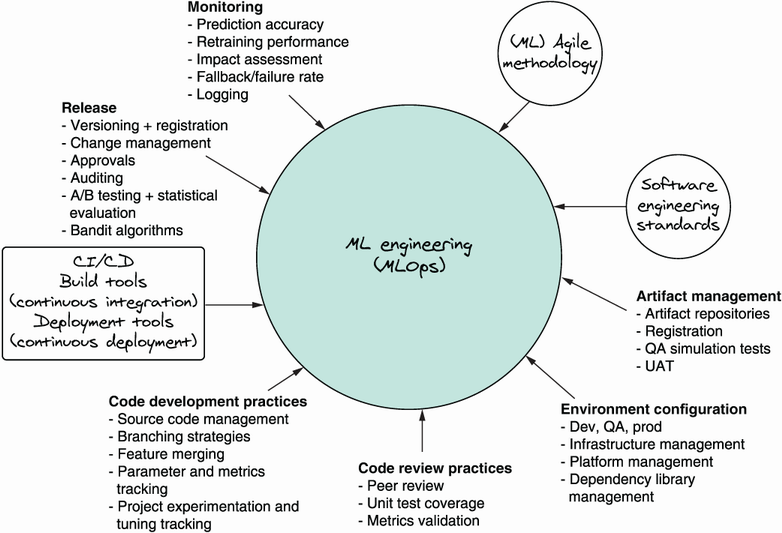
Relate POC validation to the later MLOps productionization phase, where models are shipped to production. section 1.1.1

How Designing Deep Learning Systems: A guide for software engineers covers it

How deep it goes
Explains iterative evaluation and practical trade-offs, but stops short of production pipeline and hosting implementation.
Examples
Uses multiple pilot algorithms, explored datasets, and stakeholder feedback as the working artifacts.
What it assumes
Assumes explored data and a defined business requirement, while allowing data scientists to perform research when resources are limited.
What you can do after
Evaluate competing approaches and decide whether an algorithm and dataset justify production investment.
How it connects
Links data exploration, prototyping, training algorithms, product feedback, productionization, and model hosting.

This explainer was generated by Manning's knowledge graph from the text of Designing Deep Learning Systems: A guide for software engineers. The section links point to the parts of the book it draws on.