Proportional gain (Kp) is the PID parameter that scales the controller’s response to the current error. Increasing Kp generally decreases rise time and steady-state error, but increases overshoot. section 8.7
In a closed-loop system, Kp appears alongside integral gain and derivative gain in the PID transfer function. Its effect is practical rather than isolated: tuning Kp changes the system’s step response and must be judged against competing response characteristics. section 8.7
HVAC temperature control
For a heater responding to the difference between actual and desired temperature, proportional action produces a control response based on that error. A step response can then reveal rise time, overshoot, settling time, and steady-state error while Kp is varied or optimized with the other PID parameters. section 8.7
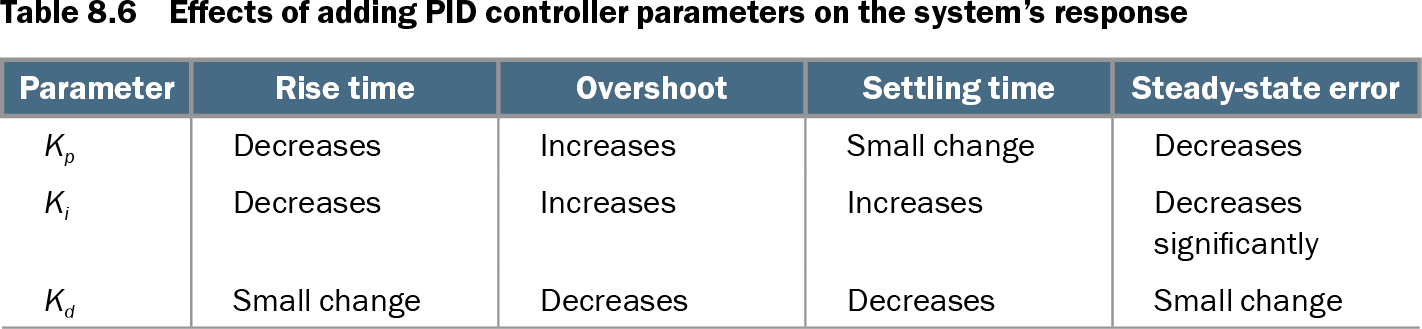
Table 8.6 Effects of adding PID controller parameters on the system’s response (view table figure)
| Parameter |
Rise time |
Overshoot |
Settling time |
Steady-state error |
|---|---|---|---|---|
| Kp |
Decreases |
Increases |
Small change |
Decreases |
| Ki |
Decreases |
Increases |
Increases |
Decreases significantly |
| Kd |
Small change |
Decreases |
Decreases |
Small change |
Compare how Kp, Ki, and Kd alter rise time, overshoot, settling time, and steady-state error. section 8.7