A protected attribute is a personal characteristic, such as ethnicity or gender, whose use or influence in an automated decision raises fairness requirements. A loan model should not change its decision because a person belongs to a different ethnic group. section 8.1.3
Excluding the attribute from the input does not necessarily remove its influence. Neighborhood, social network, and shopping-habit features may act as proxies that let a model reproduce effects associated with ethnicity or another protected attribute. section 8.1.3
Counterfactual fairness analysis tests whether changing an attribute or its proxies would change the prediction:
- Identify features corresponding to the protected attribute, including possible proxies. section 8.1.3
- Ask whether the person would have received a different classification under the counterfactual attribute value. section 8.1.3
- Use the result to identify potential bias or inform training techniques intended to produce fairer algorithms. section 8.1.3
Loan approval
For a rejected applicant, ask: “Would this person have been approved if they were of a different ethnicity?” Evaluate corresponding changes in ethnicity proxies and check whether the outcome changes. section 8.1.3
Figure 8.3 For counterfactual fairness, suppose we want to test whether the algorithm has a bias against certain ethnicities. For a given feature vector, an ethnicity element, and a corresponding “reject” outcome, we test if the outcome would change if the ethnicity element changed.
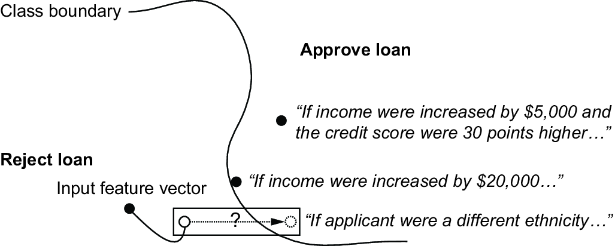
Visualizes the counterfactual fairness test by comparing a rejection with the outcome after changing the ethnicity element. section 8.1.3
