A protein backbone is the repeating chain of main-chain atoms linking amino acid residues. Each amino acid contributes an N–Cα–C framework, joined to neighboring residues through peptide bonds; side chains provide the variable groups. section 12.1.1
The backbone provides the structural thread connecting protein organization levels:
- Primary structure records the linear amino acid sequence. section 12.1.1
- Secondary structure describes local backbone geometry, especially alpha-helices and beta-strands, stabilized largely by backbone hydrogen bonding. section 12.1.1
- Tertiary structure arranges backbone-supported secondary elements and connecting loops into a complete three-dimensional protein fold. section 12.1.1
Figure 12.3 Primary structure is the linear sequence of amino acids. Secondary structure is local backbone geometry—chiefly alpha-helices and beta-strands—stabilized largely by backbone hydrogen bonding. Tertiary structure is the full three-dimensional arrangement of a single polypeptide chain, including how its secondary-structure elements and connecting loops pack together. Quaternary structure describes an assembly of more than one chain.
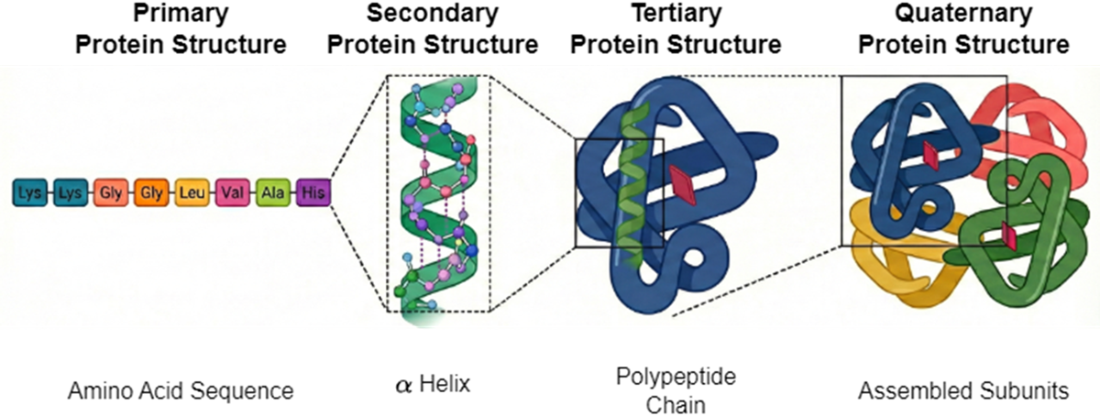
Use the structural-level comparison to distinguish sequence, local backbone geometry, single-chain folding, and multi-chain assembly. section 12.1.1
