A protein–protein interaction network (PPI network) is a monopartite graph whose nodes represent proteins and whose edges represent experimentally documented interactions. In a disease knowledge graph, it connects disease-associated proteins and supports pathway discovery. section 4.2.1 section 4.2.3
A practical PPI-to-disease analysis pipeline:
- Create unique node-key constraints for Protein and Disease nodes. section 4.2.1
- Import protein pairs from CSV, merge protein nodes, and create INTERACTS_WITH relationships in transactions. section 4.2.1
- Add disease–protein associations, disease classes, and gene metadata to form a multisource knowledge graph. section 4.2.1
- Extract each disease pathway as the interactions among proteins associated with that disease. section 4.2.3
Celiac-disease pathway analysis
For celiac disease, collect associated proteins, retrieve their interactions, convert the result to an undirected NetworkX graph, and calculate pathway density. Additional measures include the largest connected component and conductance, which counts interactions crossing from disease proteins to the rest of the PPI network. section 4.2.3
Figure 4.4 A disease pathway is a subgraph of the PPI network defined by a set of proteins associated with the disease.
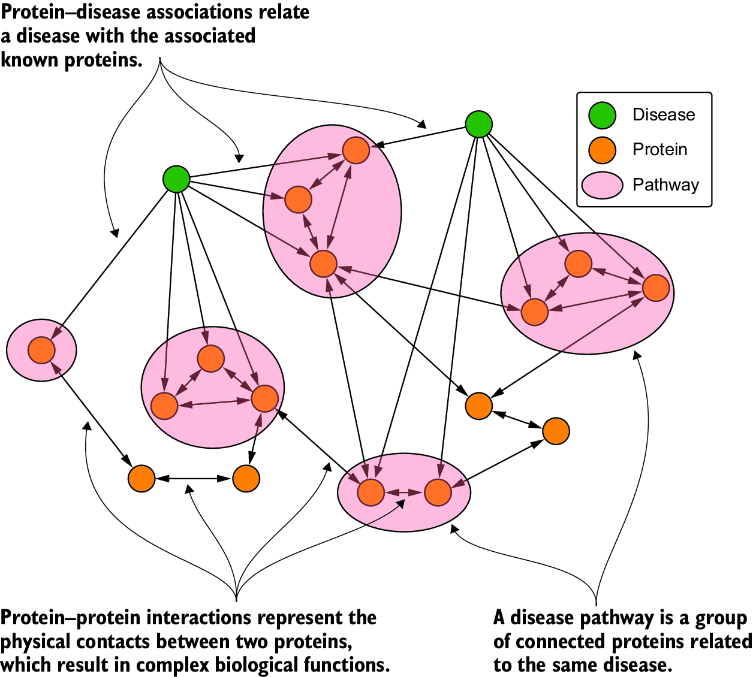
Use the pathway diagram to see how a disease-associated protein set defines a subgraph of the global PPI network. section 4.2.3
