A proxy server sits between applications and manages their TCP/IP connections. It forwards traffic and can filter or modify it according to its configuration. In a service mesh, proxies add communication controls without requiring changes to application code. section 8.4.2
Configure a proxy for the behavior a service needs:
- Validate a web token before a request reaches an API. section 8.4.2
- Retry a connection before returning a failure to the calling application. section 8.4.2
- Encrypt traffic between proxies in front of communicating services. section 8.4.2
In Kubernetes, proxies run on top of the container network defined by the Container Network Interface (CNI). Deployment choices include a proxy per pod, one shared by pods on a node, or one for the cluster. Sharing makes service-specific policies, fine-grained traffic control, isolation, and granular observability harder. Choose the placement according to the control and visibility each service requires. section 8.4.2
Figure 8.5 A service mesh acts as a control plane for proxy servers, deploying and configuring them based on our instructions, creating a standardized way of utilizing this integration point.
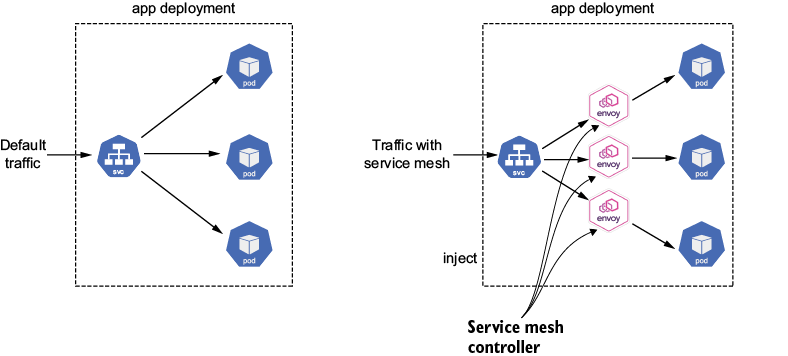
The diagram shows how a service mesh deploys and configures proxies as a standardized integration point. section 8.4.2


