A proxy objective is an optimization target that stands in for a harder-to-measure goal. It is useful when the desired outcome—such as downstream user satisfaction or human intent—cannot be supplied directly as a reliable training reward. The central risk is that correlation is not identity: improving the proxy can eventually stop improving the real goal. section 14.1.1 section 5.0
In reinforcement learning from human feedback (RLHF), a trained reward model commonly supplies the proxy objective. The RL algorithm receives the model’s scalar score as reward, while the intended objective is higher-quality behavior for users. Reward modeling therefore converts difficult-to-specify preferences into a signal that can drive optimization, but the learned signal remains an approximation. section 14.1.1 section 5.0
A proxy objective differs from a direct objective in several operationally important ways:
- It can make optimization feasible by compressing complex human preferences into a reward signal usable by downstream training. section 5.0
- It can be improved while the real objective worsens. Under over-optimization, training reward continues rising, but downstream quality peaks and then declines. section 14.1.1
- It is not simply overfitting. Overfitting concerns generalization across data splits for the same metric; over-optimization exposes a mismatch between the metric and the intended goal. section 14.1.1
- It requires controlled optimization, including regularization, because greater optimization power can exploit imperfections in the reward signal. section 14.1.1 section 1.2
Reward-model score versus user satisfaction
Suppose human labelers score chatbot responses in a controlled setting and a reward model learns to predict those judgments. RL can optimize that model’s score directly, yet the score is only a proxy for what downstream users want. Pushing optimization too far may yield responses that score better without becoming more useful to users. section 14.1.1 section 5.0
Figure 5.1 The RM in RLHF plays the role of the environment component that returns rewards in standard RL. The key difference is that in RLHF, we get to control and learn this reward function from human preferences, rather than it being fixed by the environment.
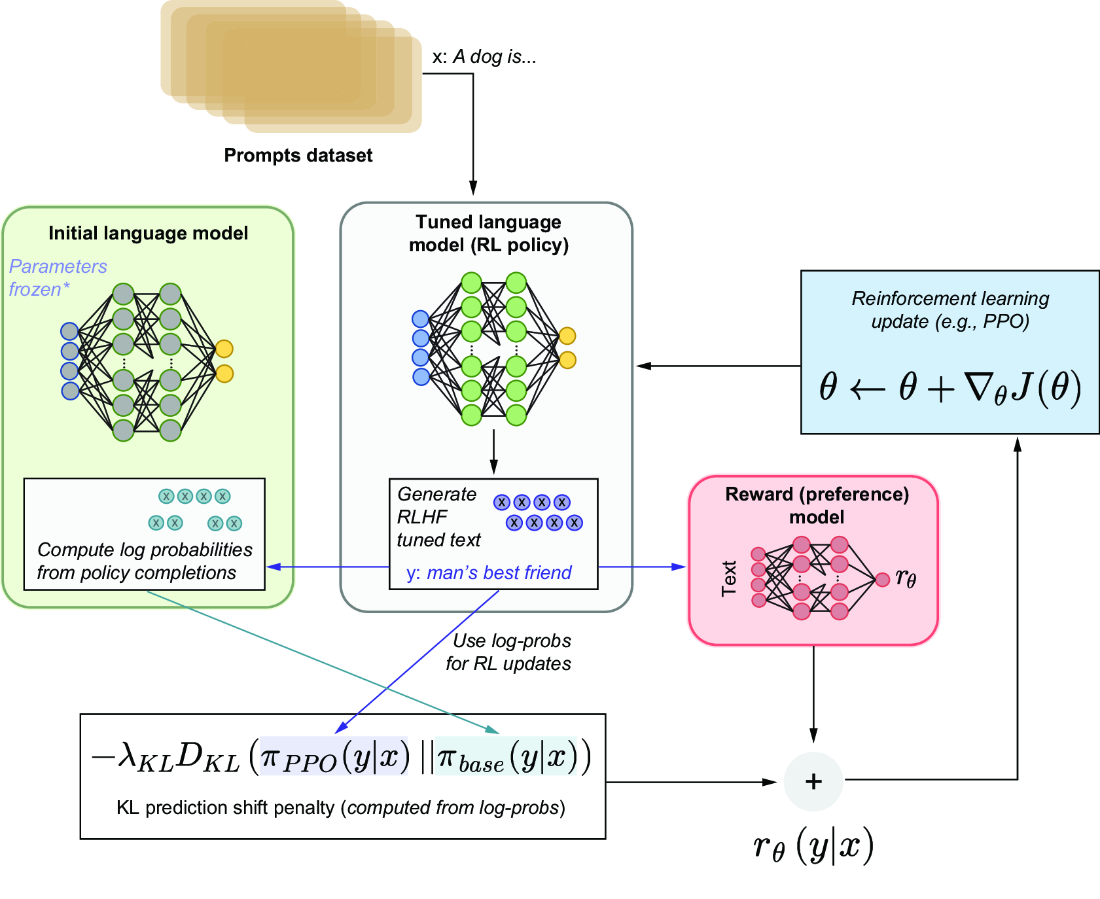
A reward model occupies the reward-providing role that a fixed environment occupies in standard RL, except its reward function is learned from human preferences. section 5.0
Proxy objectives are not inherently failures; they are the practical mechanism that makes preference-based optimization possible. The implementation task is to treat reward-model improvement as evidence rather than proof of real-world improvement, and to monitor downstream quality alongside the optimized reward. section 14.1.1 section 1.2
