A proxy problem is an easier, better-behaved version of a task that still correlates with the desired solution. Machine-learning systems optimize the proxy when the real goal is difficult to optimize directly. section 4.1.1
Cancer prediction
Accuracy counts correct predictions, so 48 correct predictions out of 50 is meaningful but 48.2 is not. Because accuracy is not smooth, training can use cross-entropy loss as a proxy instead. The proxy is easier to optimize, but it may not perfectly match the intended goal. section 4.1.1
This creates a practical risk: training focuses on what the system can learn effectively, not always on what people ultimately want. The mismatch can produce unexpected results or low performance. section 4.1.1
Figure 4.2 Examples of a smooth function on the left and two nonsmooth functions on the right. The center example is mostly smooth, but one region is not smooth because the function has no value. On the right, the function is not smooth anywhere due to the hard change in value.
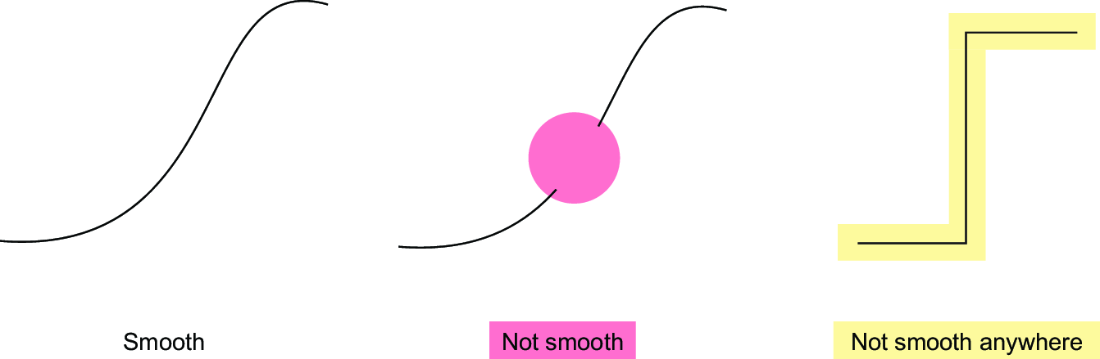
Compare smooth and nonsmooth functions to see why optimization may require a better-behaved proxy. section 4.1.1
