liveBook · Manning

Proxyless approach

As explained in Google Anthos in Action

A proxyless approach is a service-mesh communication model in which a service sends telemetry and communicates with the control plane without a sidecar proxy.

A proxyless approach lets a microservice send telemetry directly to the service-mesh control plane through gRPC, without attaching a sidecar proxy or changing application traffic flow to pass through one. section 4.2

The deployment model has these practical implications:

  • The microservice communicates directly with the control plane rather than relying on an Envoy sidecar to observe inbound and outbound traffic. section 4.2
  • Developers avoid implementing monitoring probes in application code while operations teams retain real-time visibility across the service mesh. section 4.6
  • Proxyless deployment is one option alongside sidecar proxies and proxies running inside virtual machines. section 4.2
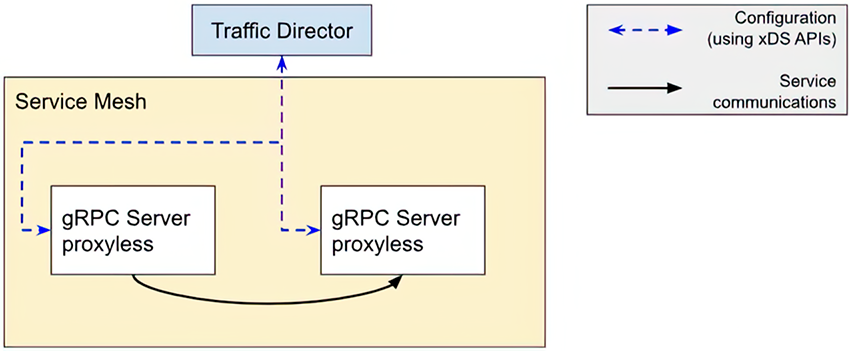
Figure 4.3 Proxyless approach
04-03

Use the proxyless architecture figure to compare direct service-to-control-plane telemetry with sidecar-based communication. section 4.2

How Google Anthos in Action covers it

How deep it goes
Defines direct gRPC telemetry and contrasts proxyless deployment with sidecars, but does not provide configuration procedures.
Examples
Uses direct gRPC telemetry and a proxyless architecture figure as concrete examples.
What you can do after
Operate service-mesh observability without adding monitoring probes to application code.
How it connects
Connects service meshes with control planes, telemetry, gRPC, sidecar proxies, Envoy, and virtual-machine proxies.

Related concepts

This explainer was generated by Manning's knowledge graph from the text of Google Anthos in Action. The section links point to the parts of the book it draws on.