liveBook · Manning

Pseudocount

As explained in Grokking Bayes

A pseudo-count is a numerical quantity representing prior evidence equivalent to a count of observations in a conjugate Bayesian model.

A pseudocount represents prior evidence as though observations had already been counted. In a binomial model, Beta prior parameters α and β act like prior counts of successes and failures. section 3.9

The size of the pseudocounts expresses confidence in the prior proportion:

  • Beta(1, 1) acts like 1 prior head and 1 prior tail when little is known. section 3.9
  • Beta(20, 20) acts like 20 prior heads and 20 prior tails, favoring 0.5 with more confidence. section 3.9
  • Beta(100, 100) expresses strong confidence that the proportion is 0.5. section 3.9

Tea drinkers

A prior with 4 tea drinkers and 3 coffee drinkers encodes an estimated office preference before observing new data. Larger equivalent counts make the posterior less responsive to limited observations. section 3.9

Figure 3.3 Comparison between the posterior distributions of 𝑝 under different prior distributions.
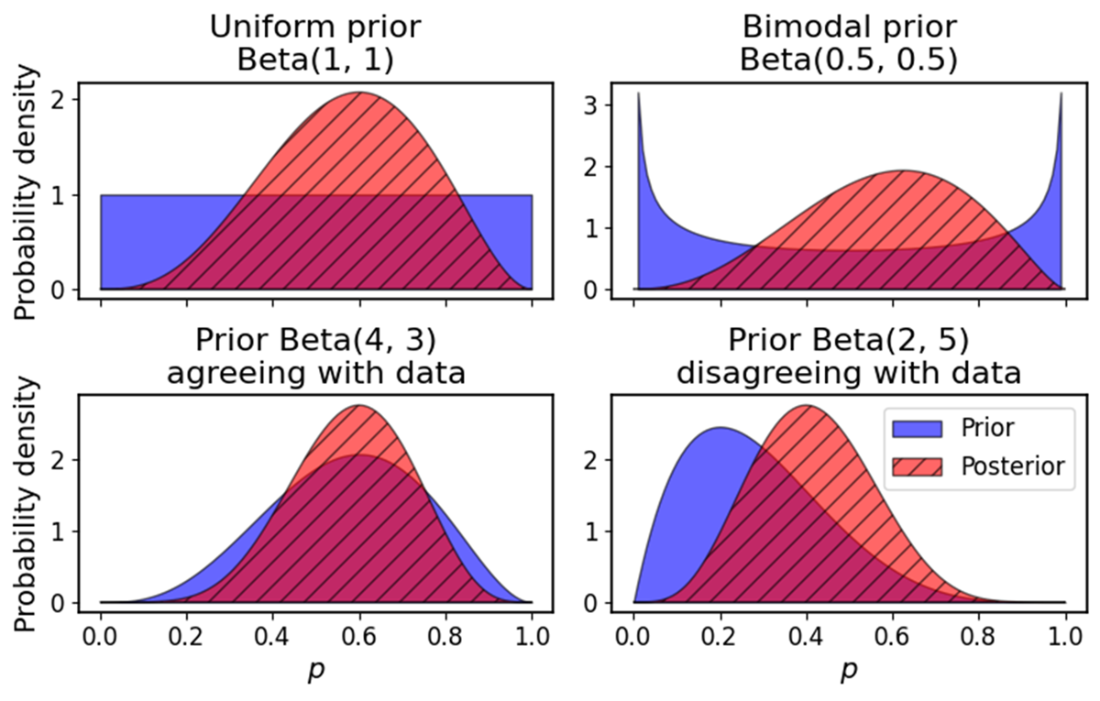
Compare posterior distributions under different priors to see how pseudocount size changes concentration and confidence. section 3.9


How Grokking Bayes covers it

How deep it goes
Explains α and β as success and failure counts through Beta-prior examples, without developing broader conjugate-prior families.
Examples
Uses tea-versus-coffee preferences, heads and tails, defective items, marketing responses, and advertising click-through rates.
What it assumes
Assumes proportions and success-failure outcomes while introducing prior beliefs through equivalent observations.
What you can do after
Apply it via Beta prior parameters to encode prior proportions and confidence before updating with binomial data.
How it connects
Connects Bayesian priors, Beta distributions, binomial models, posterior distributions, and hyperparameters.

Also explained in

Compare how 2 books explain pseudocount →

Related concepts

This explainer was generated by Manning's knowledge graph from the text of Grokking Bayes. The section links point to the parts of the book it draws on.