liveBook · Manning

Purpose-driven approach

As explained in Knowledge Graphs and LLMs in Action

Purpose-driven knowledge graph development is an approach that begins by defining business objectives and builds the knowledge graph around them.

A purpose-driven approach builds a knowledge graph around business objectives instead of importing every available dataset. Objectives narrow data selection, shape the graph’s content and structure, and produce a domain-specific, customizable source of truth. section 2.6 section 2.7

Use an iterative pipeline:

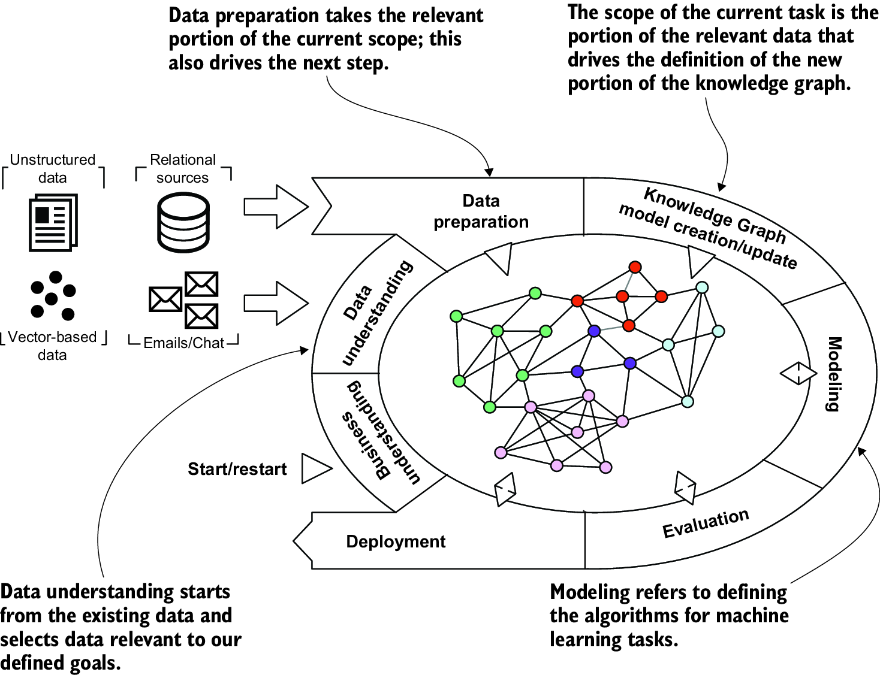
  • Define business understanding and functional goals. section 2.6
  • Focus data understanding on the portions relevant to those goals. section 2.6
  • Acquire and transform selected data into the graph; use LLMs to extract entities and relationships from unstructured content. section 2.6
  • Model and test algorithms, evaluate results, then package the schema, models, ingestion pipelines, and post-processing into a deployable product. section 2.6
Figure 2.14 CRISP-DM revisited, applied to KG platforms. The KG is used as a model of the knowledge base for the intelligent system. It is the center of the revisited CRISP-DM process.
figure

Use the revisited CRISP-DM architecture to see the knowledge graph positioned at the center of the intelligent-system development cycle. section 2.6

How Knowledge Graphs and LLMs in Action covers it

How deep it goes
Traces a CRISP-DM-inspired pipeline from business understanding through acquisition, modeling, evaluation, productization, and deployment.
Examples
Uses targeted data selection, LLM entity and relationship extraction, algorithm testing, model reports, and deployable ingestion pipelines.
What it assumes
Assumes business objectives and established machine-learning project methodology while defining the graph-centered workflow.
What you can do after
Apply a goal-driven workflow to build, evaluate, and deploy a domain-specific knowledge graph and its supporting models.
How it connects
Connects knowledge graphs with CRISP-DM, large language models, data acquisition, machine learning, evaluation, and deployment.

This explainer was generated by Manning's knowledge graph from the text of Knowledge Graphs and LLMs in Action. The section links point to the parts of the book it draws on.