liveBook · Manning

PyTorch Lightning

As explained in Machine Learning for Tabular Data: XGBoost, Deep Learning, and AI

PyTorch Lightning is a high-level PyTorch framework that structures and abstracts common model-training workflows.

PyTorch Lightning is a high-level API for PyTorch that abstracts the training loop. It provides structure without replacing PyTorch as the underlying deep-learning framework. section 8.1

Use its position in the stack to compare practical options for tabular deep learning:

  • PyTorch supplies the low-level deep-learning framework, while Lightning abstracts a focused part of its workflow. section 8.1
  • fastai provides a broader high-level PyTorch API, whereas Lightning concentrates on the training loop. section 8.1
  • Lightning Flash builds on Lightning as a higher-level library for prototyping, baselining, fine-tuning, and deep-learning problems. section 8.1
  • For tabular data, valid alternatives include PyTorch with fastai, TabNet, PyTorch Tabular, or Lightning Flash. section 8.7
Figure 8.3 Deep learning stacks for tabular data
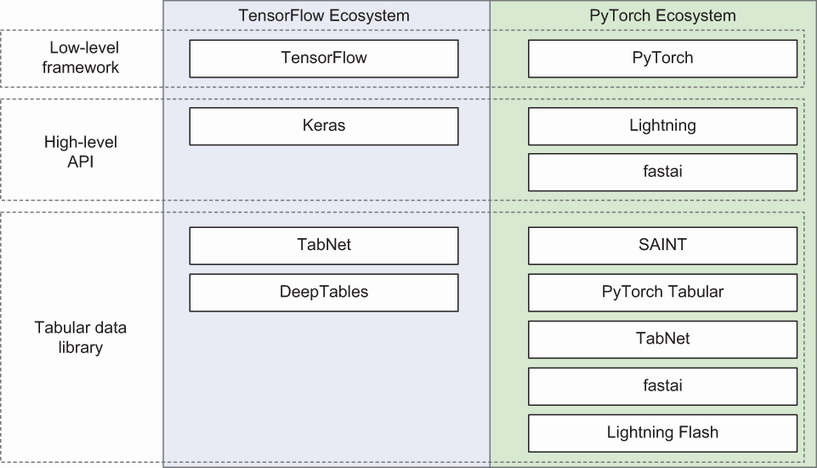
Use the stack diagram to locate PyTorch Lightning among low-level frameworks, high-level APIs, and tabular-data libraries. section 8.1


How Machine Learning for Tabular Data: XGBoost, Deep Learning, and AI covers it

How deep it goes
Defines Lightning’s abstraction boundary but stops short of implementation details, setup instructions, or a worked training workflow.
Examples
Compares PyTorch Lightning with fastai and places Lightning Flash among valid Colab stacks for tabular deep learning.
What you can do after
Evaluate/understand PyTorch stack choices and distinguish Lightning’s training-loop abstraction from Lightning Flash’s broader tooling.
How it connects
Connects PyTorch with fastai, Lightning Flash, TabNet, PyTorch Tabular, TensorFlow, and Keras.

Also explained in

Compare how 2 books explain PyTorch Lightning →

Related concepts

This explainer was generated by Manning's knowledge graph from the text of Machine Learning for Tabular Data: XGBoost, Deep Learning, and AI. The section links point to the parts of the book it draws on.