QDQ format represents quantized operators in ONNX graphs with QuantizeLinear and DequantizeLinear nodes. A runtime can fuse these nodes with an operator into a native INT8 kernel. section 6.5
ResNet-18 static quantization
The graph wraps Conv, Add, MaxPool, and GlobalAveragePool operators in QDQ pairs. It reaches 100% operator coverage; runtime fusion reduces 48 compute ops to 31, with 108 QDQ nodes handling data-type transitions. section 6.5
Figure 6.8 Operator quantization coverage by ONNX variant. Left: ResNet-18 ORT Dynamic — 4% coverage, only 1 MatMulInteger node (the classification head's Gemm) out of 51 compute ops. All 20 Conv and 17 Relu stay in FP32. Center: ResNet-18 ORT Static — 100% coverage, all 20 Conv, 8 Add, and the Gemm wrapped in QDQ pairs. Right: BERT-base ORT Dynamic — 28% coverage, 74 MatMulInteger nodes (the linear projections) quantized, but LayerNormalization, Softmax, Div, and Sqrt remain in FP32.
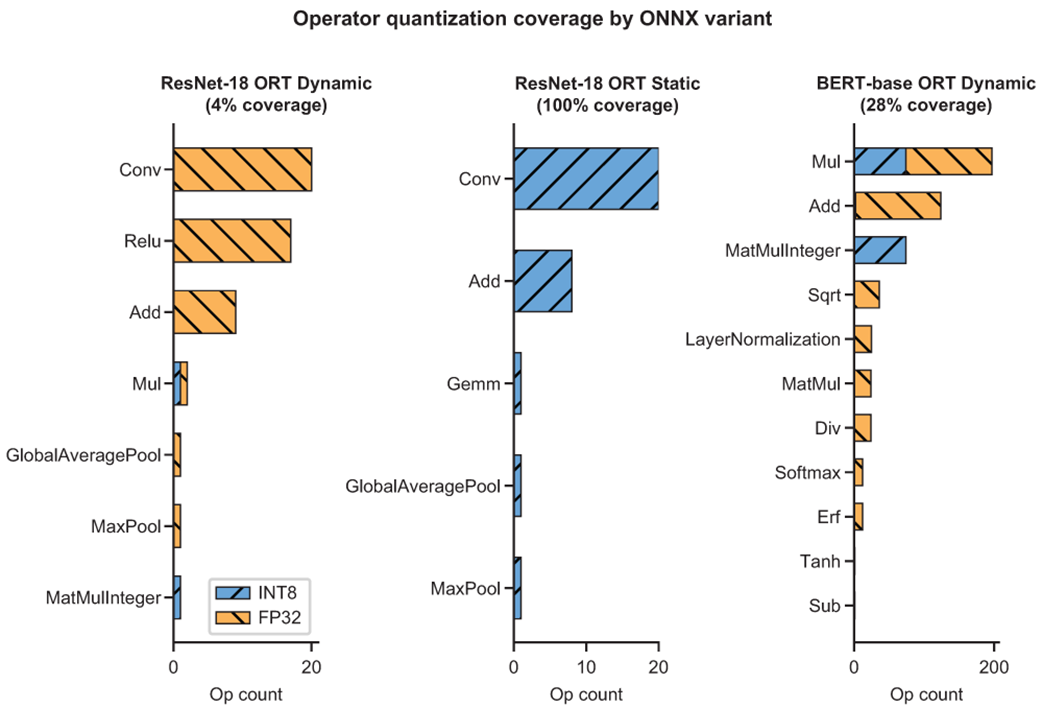
Compare QDQ-based static coverage with dynamic quantization coverage for ResNet-18 and BERT-base. section 6.5
