Qdrant is a vector database used here to store agent episodes and retrieve those most similar to a new task. QdrantMemoryStore connects it to a BaseMemoryStore interface. section 7.3.2
The store’s workflow is straightforward:
- Write an episode by deriving searchable text, converting it to a Qdrant point, and upserting it into a collection. section 7.3.2
- Recall episodes by embedding a query, searching for the most similar points, and limiting results with max_results. section 7.3.2
Recall a related task
Store episodes for Hailstone sequences starting at 6 and 8, then query for a sequence starting at 6. With max_results=1, recall returns the episode for 6. section 7.3.2
Figure 7.5 Recording an Episode as a point in the embedding space and recalling the most similar Episode objects to a given query
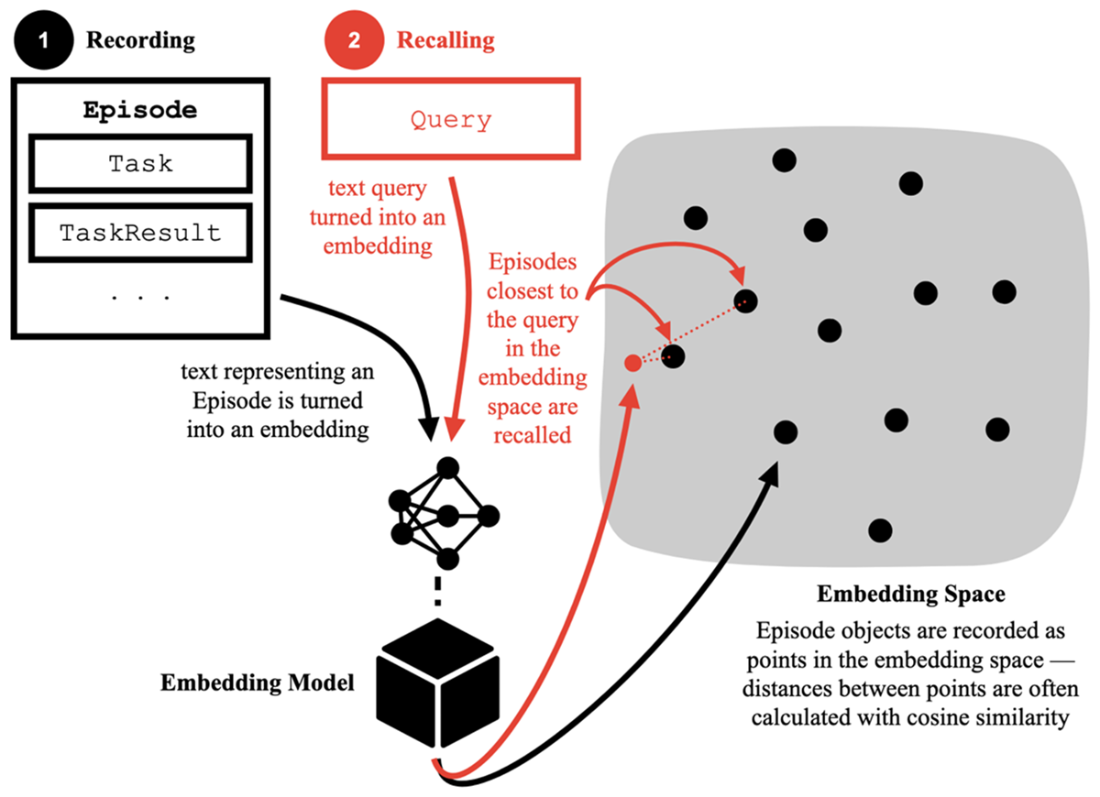
See how episodes and a query are represented in embedding space for similarity-based recall. section 7.3.2
Listing 7.7 Implementing QdrantMemoryStore: _search()
# llm_agents_from_scratch/memory_stores/qdrant/store.py
… #A
from llm_agents_from_scratch.memory_stores.qdrant.utils import (
    qdrant_point_to_episode,
)

class QdrantMemoryStore(BaseMemoryStore):
    … #B

    async def _search(
        self,
        query: str,
        **kwargs: Any,
    ) -> list[Episode]:
        """Return the top ``max_results`` episodes most similar to ``query``.""" #C
        await self._ensure_collection()
        similar_points = (
            await self._client.query_points( #D
                collection_name=self._collection_name,
                query=models.Document( #E
                    text=query,
                    model=self._client.embedding_model_name,
                ),
                using=self._client.get_vector_field_name(),
                limit=self.max_results, #F
                with_payload=True,
                **kwargs,
            )
        ).points
       return [qdrant_point_to_episode(p) for p in similar_points] #G
Inspect the asynchronous search implementation and its result limit. section 7.3.2