A structure–property relationship describes how molecular structure corresponds to a chemical, biological, or functional property. Quantitative structure–property relationship (QSPR) is the general form; quantitative structure–activity relationship (QSAR) focuses specifically on activity. In virtual screening, the relationship connects structural features with measured compound behavior. section 2.1.1
Use the relationship as a practical reasoning and modeling workflow:
- Represent molecules through structural features, then compare compounds using a similarity metric that measures shared features. section 2.1.3
- Train a machine-learning model when labeled positive and negative compounds are available, allowing it to learn which substructures correlate with activity. section 2.1.1 section 2.1.3
- Apply the idea beyond activity to properties such as toxicity, drug-likeness, size, solubility, and permeability. section 2.1.1
Why similarity is not enough
Two molecules may share substantial structural similarity yet differ in desired functionality because some structural features matter, others are irrelevant, and others contradict the property. A model trained on known antimalarial compounds can learn which substructures most influence antimalarial activity. section 2.1.3
Figure 2.3 Structure-property relationships are nuanced. Discovering similar molecules doesn’t guarantee desired, similar function with respect to a query molecule.
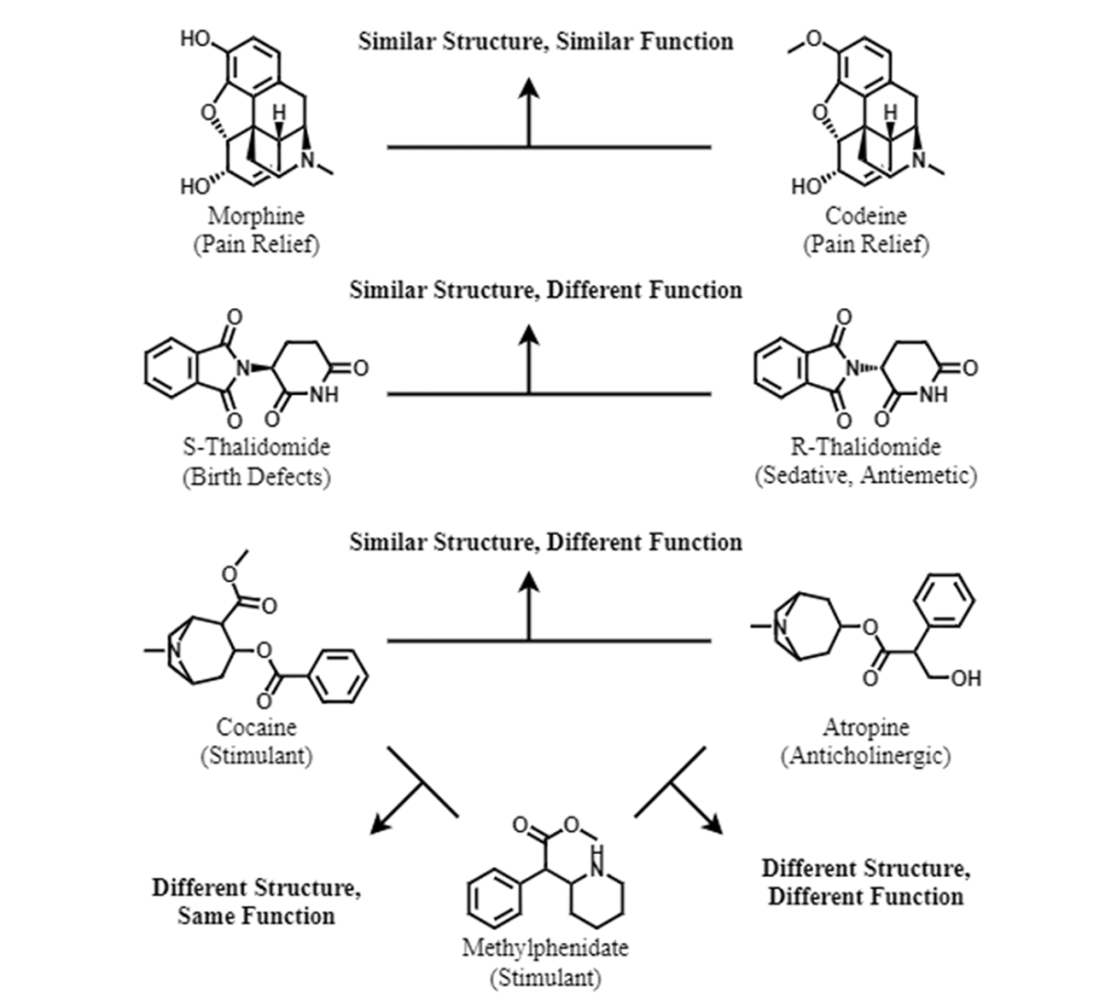
Use this figure to inspect why similar molecules do not necessarily produce similar properties or biological functions. section 2.1.3
