Quadratic growth means that work increases roughly with the square of input size: an input of n items has complexity O(n^2). Doubling the input can therefore require about four times the work. section 7.4
This growth becomes a practical limit as inputs expand. The treatment uses quadratic complexity to explain why an LLM cannot efficiently solve problems proven to require more than O(n^2) work precisely. section 7.4
Figure 7.7 A Venn diagram of computational complexities (assuming \(P \neq NP\), a minor point for the nerds) relate to each other. The top arrows give examples of the kind of problem that a new complexity class lets you solve. The bottom arrows show where LLMs land in terms of their complexity.
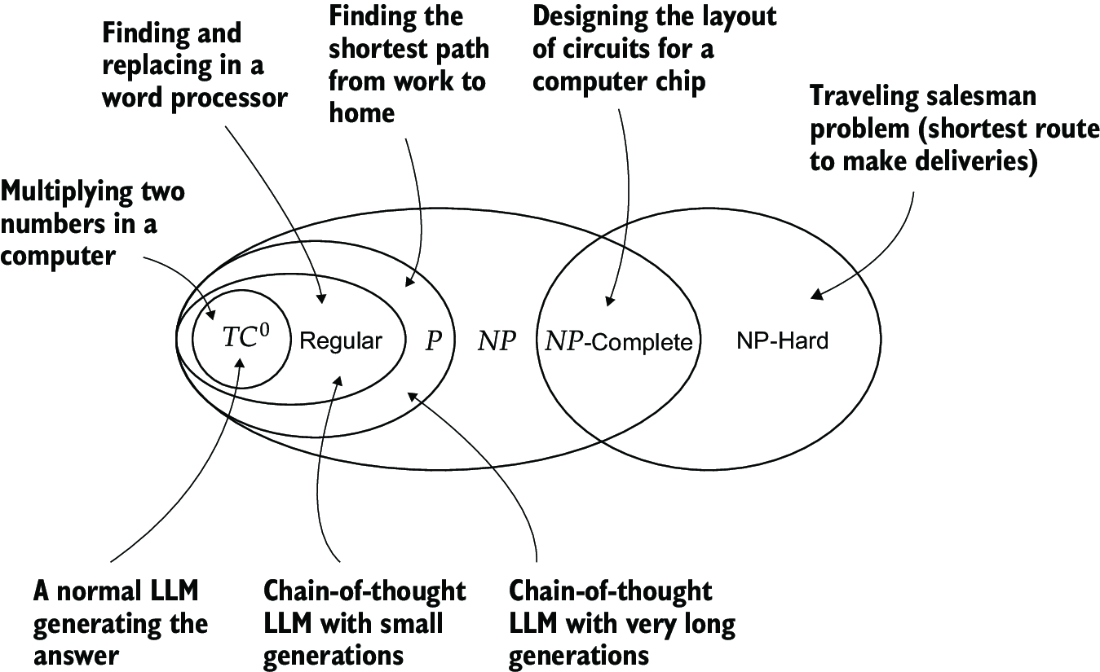
Compare quadratic growth with other complexity classes and see where LLMs are placed in that hierarchy. section 7.4



