liveBook · Manning

Quantile quantization

As explained in Machine Learning System Design

A transformation that converts continuous values into discrete buckets defined by value quantiles.

Quantile quantization transforms continuous features into categorical features by grouping values into discrete buckets. Use it when a model benefits from discrete inputs rather than raw measurements. section 11.1.2

DeepETA feature pipeline

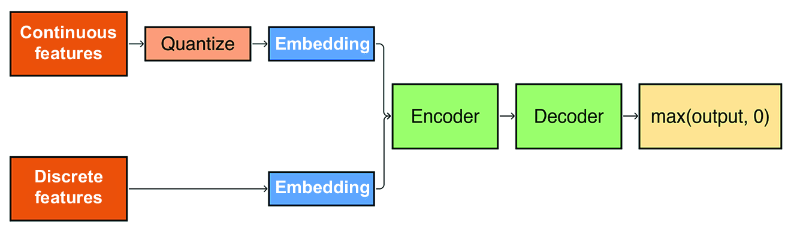
Uber’s DeepETA network transforms continuous, categorical, and geospatial data into discrete tokens, then into learnable embeddings for a transformer-based ETA model. section 11.1.2

Figure 11.1 An overview of the DeepETA model pipeline: example of combining base feature engineering and a deep learning model (source: https://mng.bz/0MoN)
figure

Use the pipeline figure to trace how feature engineering turns mixed tabular inputs into representations consumed by the deep learning model. section 11.1.2


How Machine Learning System Design covers it

How deep it goes
Defines value-based bucketing and shows an embedding pipeline, but does not detail bucket-count selection or implementation steps.
Examples
Uses Uber’s DeepETA network to illustrate transforming mixed tabular data into discrete tokens and learnable embeddings.
What it assumes
Assumes familiarity with continuous features and feature transformations while introducing their conversion into categorical buckets.
How it connects
Connects feature engineering with categorical features, embeddings, transformer architecture, and model-dependent transformations.

Also explained in

Compare how 2 books explain quantile quantization →

Related concepts

This explainer was generated by Manning's knowledge graph from the text of Machine Learning System Design. The section links point to the parts of the book it draws on.