A quantized model stores numerical values with fewer bits. Think of it as writing numbers with fewer decimal places: the result may change slightly, but the files use less space and VRAM. section 10.1.3
In a Flux workflow, quantization helps when the model is too large for available hardware:
- Choose a quantized UNET through the Load Diffusion Model node instead of loading an entire checkpoint. section 10.1.3
- Select a file such as flux1-dev-fp8.safetensors; “fp8” identifies its reduced numerical precision. section 10.1.3
- Expect similar output with a possible small quality difference, while reducing the storage burden on constrained hardware. section 10.1.3
A smaller numerical footprint
Rounding 3.14159 and 2.71828 to 3.14 and 2.72 produces 8.54 instead of a more precise product. Quantization applies the same space-saving idea to model numbers. section 10.1.3
Figure 10.5 Using the fp8 model only minorly impacts the quality of our output.
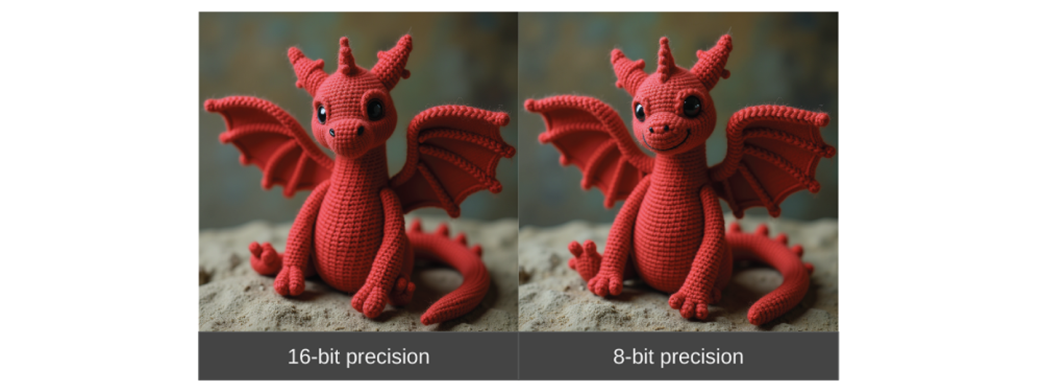
Compare the fp8 model output with the regular version to see the practical quality trade-off. section 10.1.3

