liveBook · Manning

Quantum annealing

As explained in Optimization Algorithms: AI techniques for design, planning, and control problems

Quantum annealing is an optimization method that uses quantum-mechanical fluctuations to seek low-energy solutions.

Quantum annealing (QA) searches an energy landscape for optimal or near-optimal solutions by applying quantum effects, especially quantum tunneling. section 5.2.2

Where simulated annealing uses thermal jumps to escape local minima, QA can tunnel through energy barriers, offering another way to avoid becoming trapped. section 5.2.2

QA initializes candidate states with equal weights, then changes their quantum-mechanical amplitudes gradually and adiabatically in parallel. section 5.2.2

Simulated annealing versus quantum annealing
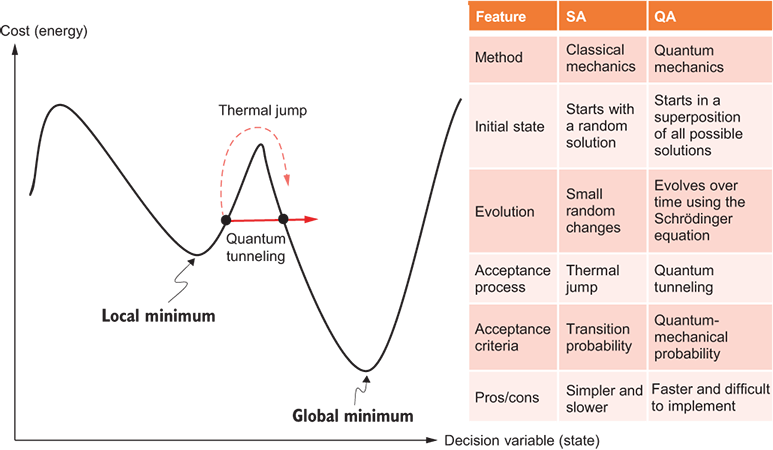
Compare thermal-jump exploration in simulated annealing with quantum-tunneling exploration in quantum annealing. section 5.2.2

How Optimization Algorithms: AI techniques for design, planning, and control problems covers it

How deep it goes
Explains tunneling, candidate-state initialization, and gradual amplitude changes, but stops short of detailed implementation steps.
Examples
Uses a simulated-annealing comparison figure and points to a D-Wave quantum-annealer implementation.
What it assumes
Assumes basic optimization and simulated-annealing concepts while introducing quantum tunneling from quantum-mechanical intuition.
What you can do after
Evaluate how quantum tunneling differs from thermal exploration when seeking approximate optimization solutions.
How it connects
Connects quantum tunneling with simulated annealing, energy landscapes, local minima, and optimization.

This explainer was generated by Manning's knowledge graph from the text of Optimization Algorithms: AI techniques for design, planning, and control problems. The section links point to the parts of the book it draws on.