Quantum system simulation computationally models physical systems governed by quantum mechanics. It is a specialized candidate for quantum computing because systems such as electrons in molecules can require far more computation to simulate classically than to describe. section 1.10 section 1.2
A simulation problem is a plausible candidate for practical quantum advantage when it has these properties:
- It is small-data and big-compute: the system description is compact, while calculating its desired properties is computationally intensive. section 1.2
- It has exploitable structure that a quantum algorithm can use. section 1.2
- It offers a substantial asymptotic improvement over the best classical algorithm and reaches a useful result quickly enough. section 1.10 section 1.2
Molecular simulation
Simulating electrons in molecules illustrates why quantum systems simulations matter in chemistry and physics: accurately reproducing quantum behavior can demand enormous classical computation. section 1.2
Figure 1.1 Quantum advantage might be achievable if the time a quantum computer takes to solve a certain problem grows at a slower rate as the problem size increases than the time a classical computer takes to do the same. In this case, problem instances that are much larger than the crossover size might be good candidates for quantum solutions. If the crossover time is months or more, quantum computing offers no practical advantage, since larger problem instances take much longer to solve, and running a quantum computer for months or years to solve a single problem is not practical.
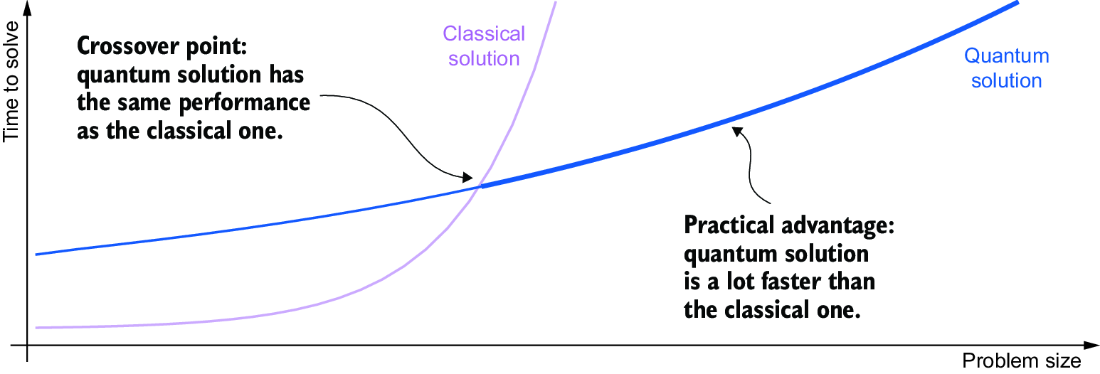
Compare quantum and classical runtime growth through the crossover size: larger instances become promising only when quantum execution remains practically fast. section 1.2
