Quantum tunneling is the ability of a particle or wave function to penetrate a potential barrier even when its total energy is below the barrier height. The probability is nonzero when the barrier is sufficiently thin. section 5.2.2
In optimization, quantum annealing applies this effect to an energy landscape. Rather than relying only on thermal jumps, it can tunnel through barriers and escape local minima while searching for an optimal or near-optimal solution. section 5.2.2
The treatment distinguishes quantum annealing from simulated annealing through these mechanisms:
- Simulated annealing uses thermal jumps to move a search particle out of local valleys. section 5.2.2
- Quantum annealing initializes candidate states with equal weights, then changes their quantum-mechanical amplitudes gradually and in parallel. section 5.2.2
- The resulting search may cross energy barriers instead of merely walking through the landscape. section 5.2.2
Simulated annealing versus quantum annealing
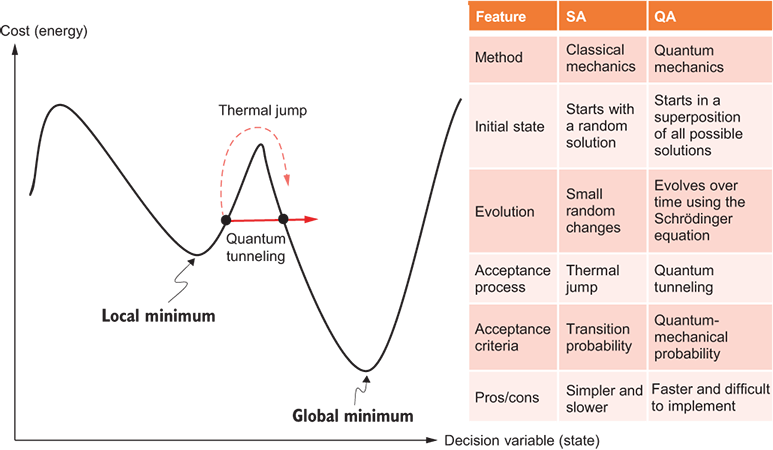
Compare the contrasting search mechanisms of simulated annealing and quantum annealing. section 5.2.2
