liveBook · Manning

Query-key-value framework

As explained in Applied Reinforcement Learning

The query-key-value framework represents each input with query, key, and value vectors to compute attention-weighted outputs.

The query-key-value framework lets each zone weigh information from other zones. A zone’s query is compared with other zones’ keys; softmax turns the scores into weights, which combine their value vectors into an output. section 9.5

Zone-to-zone attention

For a zone, dot products between its query and other zones’ keys measure relevance. The resulting weights emphasize the values of the most relevant zones. section 9.5

Figure 9.6 The Attention Mechanism — Query, Key, Value.
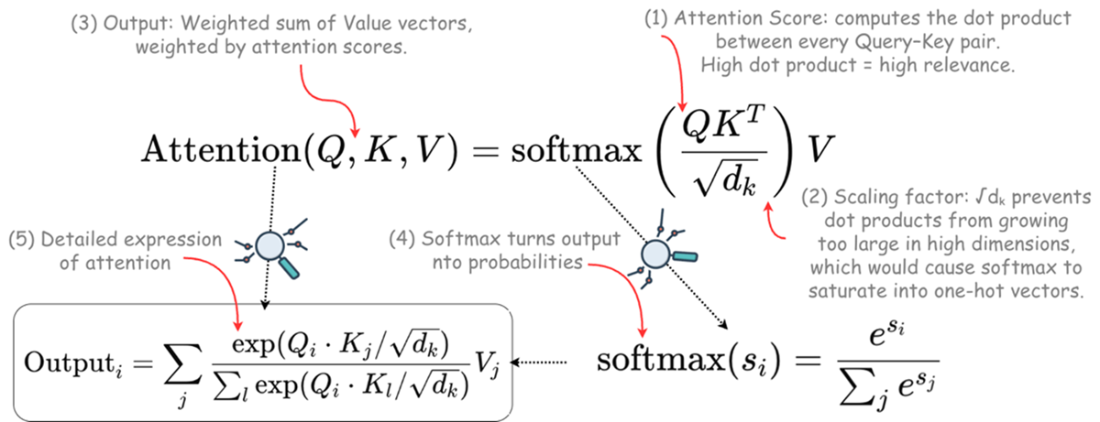
Use the diagram to follow how queries, keys, and values produce an attention output. section 9.5

How Applied Reinforcement Learning covers it

How deep it goes
Explains query-key dot products, softmax weights, and weighted value outputs.
Examples
Uses zones as entities, comparing each zone’s query with others’ keys and combining their values.
What it assumes
Introduces dot-product similarity and softmax weighting before combining zone values.
What you can do after
Understand how attention scores determine which zones contribute to each zone’s output.
How it connects
Connects attention with dot products, softmax, and adaptive feature extraction.

Related concepts

This explainer was generated by Manning's knowledge graph from the text of Applied Reinforcement Learning. The section links point to the parts of the book it draws on.