Queuing stores packets that cannot be transmitted immediately because an interface is congested. Scheduling decides the order in which queued packets are transmitted. Without QoS, an interface normally uses one egress queue and FIFO service. section 10.4
QoS can replace simple FIFO service with techniques that prioritize traffic or allocate bandwidth:
- Priority Queuing (PQ) uses up to four queues and serves higher-priority queues first; lower-priority queues can suffer starvation. section 10.7
- Class-Based Weighted Fair Queuing (CBWFQ) services queues cyclically while guaranteeing each queue a minimum bandwidth, but it may delay latency-sensitive packets. section 10.7
- Low Latency Queuing (LLQ) combines CBWFQ with a priority queue and limits priority-queue entry rates to prevent starvation of other queues. section 10.7
Congested interface
On interface G0/2 without QoS, excess packets wait in a single egress queue and leave in the order they entered it. A QoS policy can instead prioritize selected traffic. section 10.4
Figure 10.17 Packet forwarding without QoS. G0/2 has a single egress queue, and packets are transmitted in a FIFO manner.
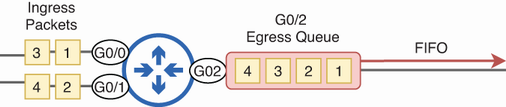
View the packet-forwarding diagram showing G0/2, its single egress queue, and FIFO transmission without QoS. section 10.4

