A radial basis function produces a value from distance to a chosen center: nearby points receive high similarity, while distant points receive low similarity. Its graph resembles a Gaussian-shaped hill. In classification, several such functions transform a dataset so a linear separator in the expanded space becomes a curved boundary in the original space. section 11.3
An RBF-based classifier works by:
- Creating similarity columns relative to selected data points, using a distance-based expression such as e^(−distance²). section 11.3
- Combining those columns so originally inseparable classes become separable by a plane in the expanded space. section 11.3
- Projecting the separating plane back to obtain a curved classification boundary. section 11.3
- Adjusting gamma: small values create wide functions, whereas large values create narrow functions. section 11.3
Separating a one-dimensional pattern
For points −1, 0, and 1 labeled 1, 0, and 1, respectively, a linear classifier cannot isolate the middle point. RBF hills at label-1 points and a valley at the label-0 point combine into a function crossing the axis twice, defining the classifier’s boundaries. section 11.3
Figure 11.20 Using an SVM with the RBF kernel to separate a nonlinear dataset in one dimension. Top: We draw a mountain (radial basis function) at each point with label 1 and a valley at each point of label 0. Bottom: We add the radial basis functions from the top figure. The resulting function intersects the axis twice. The two points of intersection are the boundary of our SVM classifier. We classify each point between them as a square (label 0) and every point outside as a triangle (label 1).
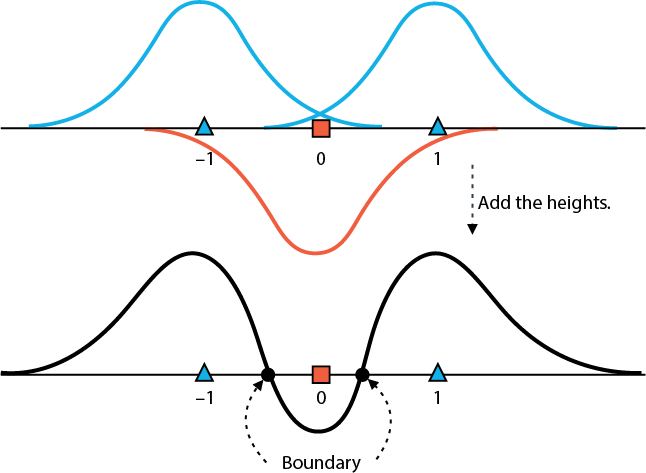
Use the figure to see how individual RBF mountains and valleys combine into two decision boundaries. section 11.3
