Suppose a straight line cannot separate triangles from squares. An RBF kernel adds a distance-based similarity around each data point, allowing an SVM to form curved decision boundaries. section 11.3 section 11.4
For points p and q, similarity decreases as their distance increases: similarity(p,q) = e^(−distance(p,q)²). Each point therefore creates a Gaussian-like bump centered at itself. section 11.3
An RBF-kernel classifier works by:
- Embedding each example into a space whose coordinates measure similarity to the data points. section 11.3
- Raising positive examples and lowering negative examples with radial basis functions. section 11.3
- Finding a separating plane in the enhanced space, whose projection becomes a curved boundary in the original space. section 11.3
A one-dimensional classifier
With label-1 points at −1 and 1 and a label-0 point at 0, no single dividing point works. The RBF model creates two bumps and one valley; their combined curve crosses zero twice, classifying the middle interval as label 0 and the outside regions as label 1. section 11.3
Figure 11.20 Using an SVM with the RBF kernel to separate a nonlinear dataset in one dimension. Top: We draw a mountain (radial basis function) at each point with label 1 and a valley at each point of label 0. Bottom: We add the radial basis functions from the top figure. The resulting function intersects the axis twice. The two points of intersection are the boundary of our SVM classifier. We classify each point between them as a square (label 0) and every point outside as a triangle (label 1).
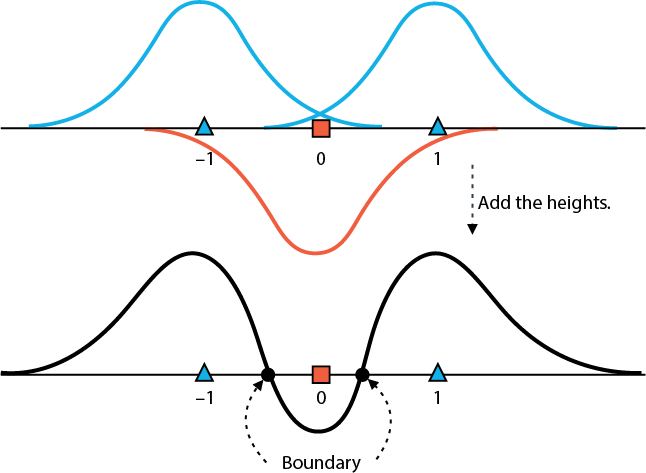
Visualizes the bumps, valleys, summed surface, and two resulting decision boundaries in the one-dimensional example. section 11.3
The gamma parameter controls each bump’s width: small gamma produces a broad surface, while large gamma produces a narrow one. Changing it changes the classifier’s boundary. section 11.3


