liveBook · Manning

Radio-frequency management

As explained in Acing the CCNA Exam: Volume 2 Advanced Networking and Security

Radio resource management is the optimization of wireless radio parameters and resources to maintain network performance and user experience.

Radio-frequency management optimizes wireless operation by setting each lightweight access point’s channel and transmit power. In a split-MAC architecture, the wireless LAN controller centralizes these non-real-time management functions while LWAPs handle real-time RF interactions. AI-enhanced radio resource management in Cisco Catalyst Center analyzes historical RF data to predict conditions and recommend configurations, reducing manual tuning. section 19.2.2 section 22.3.3

Figure 19.6 Two LWAPs managed by a WLC. The WLC handles management functions, and the LWAPs handle real-time functions.
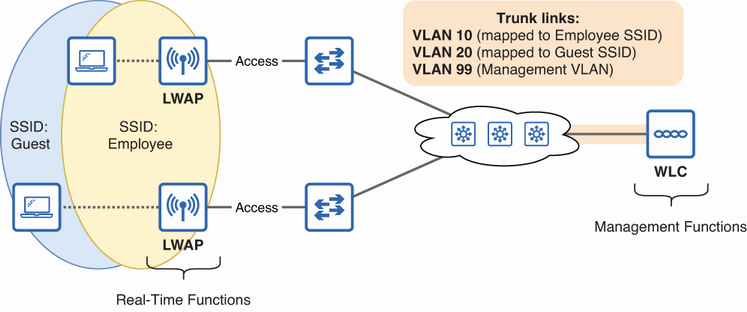
Use the architecture diagram to see centralized WLC management alongside LWAP real-time wireless functions. section 19.2.2

How Acing the CCNA Exam: Volume 2 Advanced Networking and Security covers it

How deep it goes
Defines centralized channel and power control and predictive recommendations but does not provide CLI configuration or troubleshooting procedures.
Examples
Uses LWAP channel and transmit-power settings plus historical RF analysis to recommend future wireless configurations.
What it assumes
Assumes familiarity with wireless LANs and access points while establishing WLC, LWAP, and split-MAC responsibilities.
What you can do after
Operate wireless LAN management by recognizing which RF decisions belong to the WLC and which functions remain on LWAPs.
How it connects
Connects WLCs, LWAPs, split-MAC architecture, wireless LANs, and Cisco Catalyst Center.

This explainer was generated by Manning's knowledge graph from the text of Acing the CCNA Exam: Volume 2 Advanced Networking and Security. The section links point to the parts of the book it draws on.