RAID (Redundant Array of Independent Disks) distributes or duplicates data across multiple devices to improve performance, increase redundancy, or both. RAID levels define striping, mirroring, and parity arrangements; nested levels combine these schemes. section 9.1
The tempting PostgreSQL safety net
An administrator uses RAID1 for PostgreSQL storage and adds a standby server with streaming replication, expecting double redundancy. RAID1 keeps a byte-for-byte copy on at least two devices, but it does not create an independent recovery point. Filesystem corruption is duplicated across every mirror, and RAID cannot recover data lost through corruption, human error, or malicious activity. Use PostgreSQL-aware backups, continuous archiving for Point-in-Time Recovery, and tested restores instead. section 9.1 section 9.7
Figure 9.1 A PostgreSQL installation layout demonstrating the double physical redundancy of having a standby server but also RAID1 mirrored disks in each of the servers.
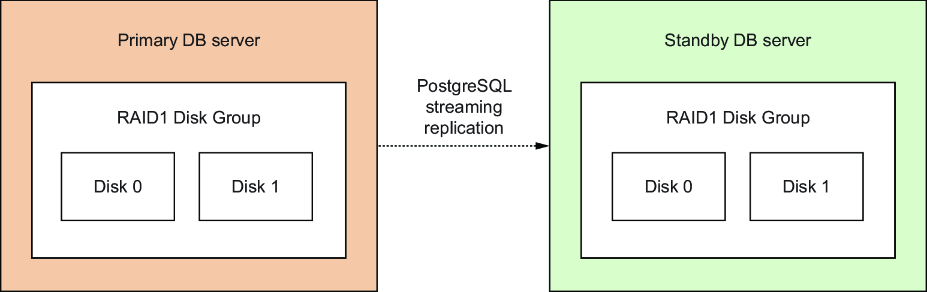
Shows how RAID1 in each server combines with a PostgreSQL standby, making the apparent redundancy—and its limits—visible. section 9.1
