A random forest tree is a randomized decision tree: at each decision node, it evaluates a randomly selected subset of features instead of exhaustively checking every feature. This prevents greedy tree learning from repeatedly favoring the same dominant features and increases diversity among trees. section 2.3.1
The split-selection process works as follows:
- Randomly sample a subset of available features before constructing a decision node. section 2.3.1
- Evaluate candidate splits only among those sampled features. section 2.3.1
- Choose the highest-scoring split from that restricted set and continue growing the tree. section 2.3.1
- Combine such trees in a random forest, alongside bootstrap sampling; classification uses majority voting, while regression uses averaged predictions. section 2.3.1 section 7.2.1
Six-feature split
With features {f1, f2, f3, f4, f5, f6}, a standard tree evaluates all six and might choose f3. A randomized tree first samples a subset, then chooses the best split only from the available features. section 2.3.1
Figure 2.7 Random forests use a modified tree learning algorithm, where a random feature subset is first chosen before the best splitting criterion for each decision node is identified. The unshaded columns represent features that have been left out; the lightly shaded columns represent available features from which the best feature is chosen, shown in the darkly shaded columns.
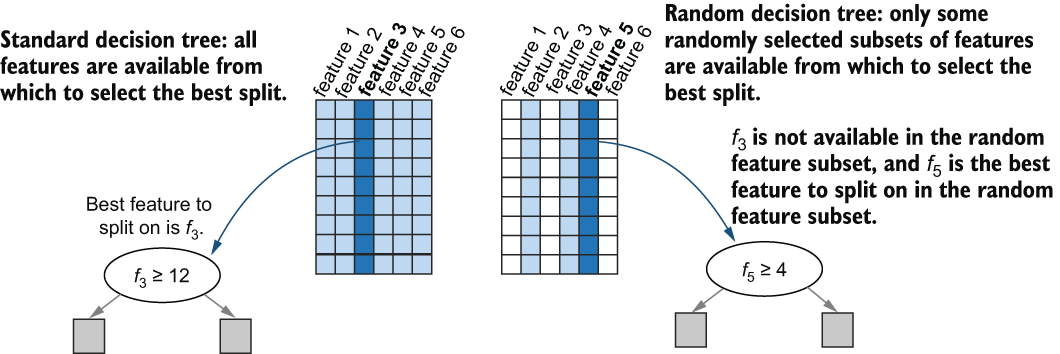
Visualizes the sampled and excluded feature columns used to construct each decision node. section 2.3.1
