liveBook · Manning

Rank leaking

As explained in Graph Algorithms for Data Science

Rank leaking is the loss of PageRank mass caused by nodes that have no outgoing relationships.

Rank leaking is the loss of PageRank mass caused by dead ends: nodes with no outgoing relationships. Without correction, rank can drain from the network and drive some or all node scores toward zero. section 5.4.1

PageRank prevents leakage through teleportation, allowing a small probability of jumping to a random node instead of following outgoing links. The damping factor controls link-following probability; a typical value is 0.85. section 5.4.1

Dead ends in a follower network

A node such as D, with no outgoing links, becomes a dead end. Running PageRank on a projected follower network uses teleportation so influence does not disappear from the graph. section 5.4.1
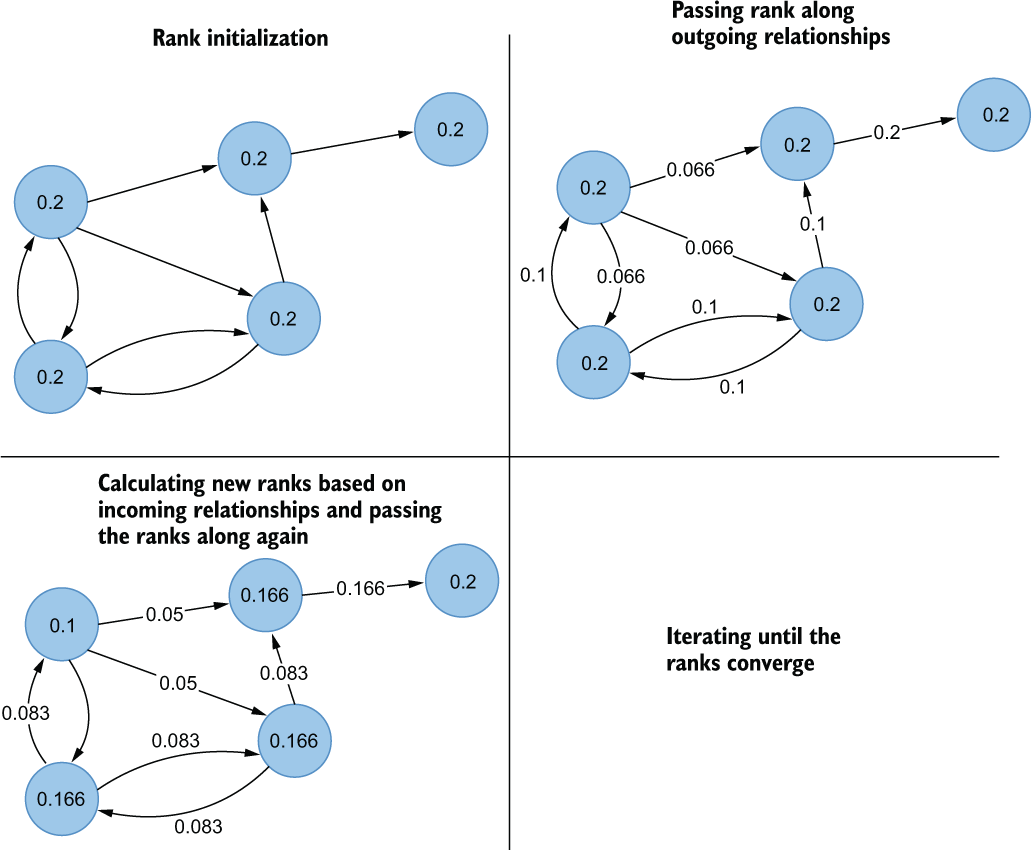
Figure 5.18 Simplified PageRank calculation based on network flow
05-18

Trace the simplified network-flow calculation that exposes how a dead end leaks PageRank. section 5.4.1

How Graph Algorithms for Data Science covers it

How deep it goes
Explains dead ends, leakage, teleportation, and damping factor, but does not develop the full iterative algorithm mathematically.
Examples
Uses node D and a projected follower network to illustrate leakage and its correction.
What it assumes
Assumes basic knowledge of nodes, outgoing links, and PageRank while defining dead ends and leakage directly.
What you can do after
Diagnose rank loss and interpret teleportation when executing PageRank on a graph.
How it connects
Connects PageRank with dead ends, teleportation, damping factor, and network flow.

This explainer was generated by Manning's knowledge graph from the text of Graph Algorithms for Data Science. The section links point to the parts of the book it draws on.