A social media feed has more posts competing for attention than a person can see. Rank order arranges items by their relative position according to a goal or measure. Posts might be ordered by time, or movies by a prediction of how much a particular user will like them. section 1.1.2 section 5.4
In a recommender system, ranking is one step in a larger process. Candidate generation narrows the pool, filtering removes items such as blocked content, and heavy ranking orders the remaining items by predicted value to the user. An optional post-processing step can adjust that order before delivery. User interactions are then recorded as feedback. section 2.2
Figure 2.1 A bird’s-eye overview of a recommender system. Recommendations are not the output of a single operation; rather, they are the results of multiple interlinked operations. Candidates are generated from the universe of all possible content—for example, by picking posts from users that are followed. Later, candidates are filtered to restrict the pool to a more manageable number. At this stage, the content gets actively sorted by the Heavy Ranker in accordance with a predefined metric. Such a ranked list can be adjusted, if needed, before being delivered to the users, whose engagement is recorded. Platform policies influence the filtering and post-processing steps, for example, by limiting the amount of content from the same author.
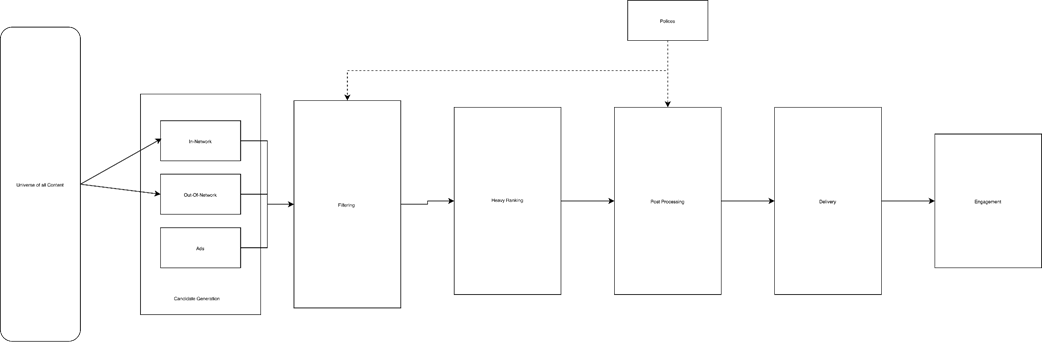
The pipeline shows where ranking sits between candidate selection and delivery, and where platform policies can influence the results. section 2.2
A post in a feed
A new post can become a candidate for its creator’s followers and, if deemed relevant, for people who do not follow the creator. In either case, it competes with other content for a position. A low-ranked post may not be seen before a user leaves the app, even by a follower. section 5.4
Ranking is not the same as choosing which items enter the list. In a network model, users’ reshares help determine the content available to rank. In an algorithmic model, the system can also add content from outside a user’s network. Both selection and ordering matter when considering amplification. section 1.2.2 section 1.3.4
These positions have consequences beyond the screen. Creators may change their content to match what they think a ranking algorithm will promote, even when it conflicts with their artistic vision. Changes to ranking can also affect their ability to reach an audience. section 1.3
