RANSAC is an iterative robust-estimation technique for fitting a model when outliers could distort the fit. It seeks a model supported by consensus subsets of data, limiting the influence of anomalous observations. section 4.5
For molecular solubility prediction, RANSAC is one of the Scikit-Learn regressors considered alongside ridge regression and support vector regression. Its practical value is robustness to noisy experimental labels and outliers, although the comparison shows a higher bias than SVR. section 4.3.3 section 4.4.2
Learning curves provide a practical way to assess the fitted RANSAC model:
- Compare training and test mean squared error as the training-set size increases. section 4.4.2
- Interpret a shrinking train-test gap as decreasing variance; the RANSAC regressor’s variance trends toward zero with more samples. section 4.4.2
- Treat its higher training error than SVR as evidence of higher bias rather than automatically preferring the more robust fit. section 4.4.2
Figure 4.19 Learning curves for RANSAC and SVR models.
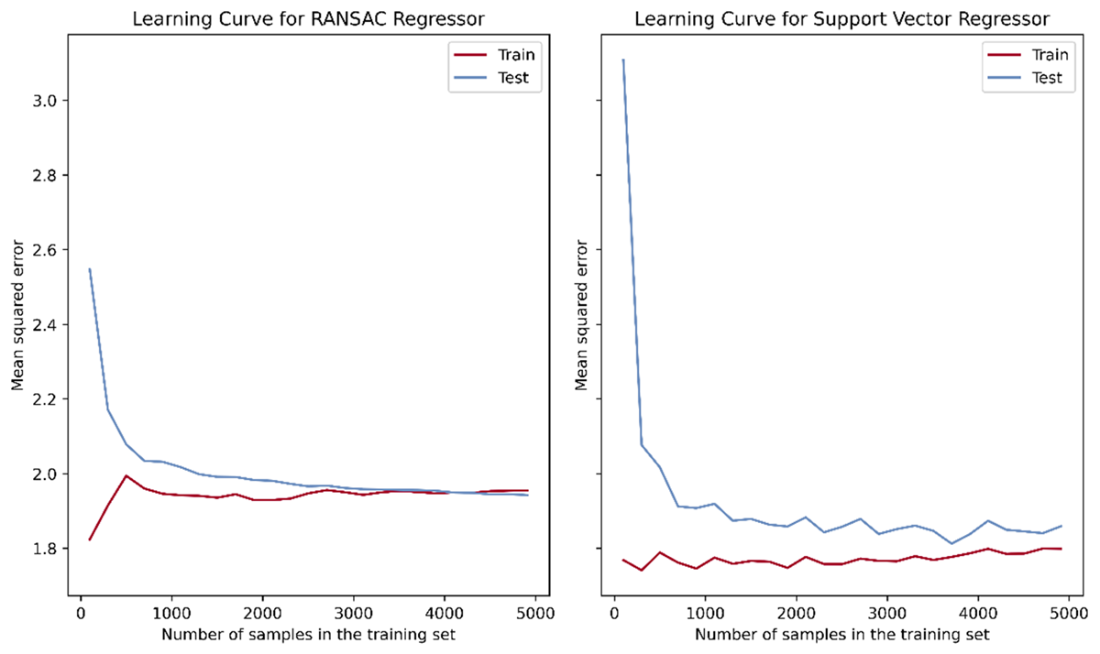
Inspect the learning-curve comparison for RANSAC and SVR to connect robustness with observed bias-variance behavior. section 4.4.2
