An attention score is an unnormalized compatibility value between a query token and an input token. In self-attention, dot products make larger scores indicate stronger potential contributions to the query’s context vector; softmax later converts each row of scores into attention weights. section 3.3.1 section 3.4.1
The computation follows a consistent tensor flow:
- With untrained self-attention, compute every score as the dot product between one input embedding and the query embedding; for query x(2), six inputs produce a length-six score vector. section 3.3.1
- For all tokens, assemble the pairwise scores as a matrix: inputs @ inputs.T. Each row corresponds to one query, and each column corresponds to a candidate input. section 3.3.2
- With trainable projections, transform inputs into queries and keys, then compute scores as queries @ keys.T rather than directly comparing input embeddings. section 3.4.1
- Scale scores by the square root of the key dimension before applying softmax; scaling limits overly sharp softmax outputs and helps avoid very small gradients. section 3.4.1
- Normalize each row with softmax to obtain attention weights, then use those weights to combine value vectors into context vectors. section 3.3.2 section 3.4.1
Six-token score vector
Using the second embedding as the query produces the unnormalized scores [0.9544, 1.4950, 1.4754, 0.8434, 0.7070, 1.0865]. Applying softmax yields [0.1385, 0.2379, 0.2333, 0.1240, 0.1082, 0.1581], whose values sum to 1. The corresponding weighted inputs produce the context vector [0.4419, 0.6515, 0.5683]. section 3.3.1
Figure 3.8 The overall goal is to illustrate the computation of the context vector z(2) using the second input element, x(2) as a query. This figure shows the first intermediate step, computing the attention scores w between the query x(2) and all other input elements as a dot product. (Note that the numbers are truncated to one digit after the decimal point to reduce visual clutter.)
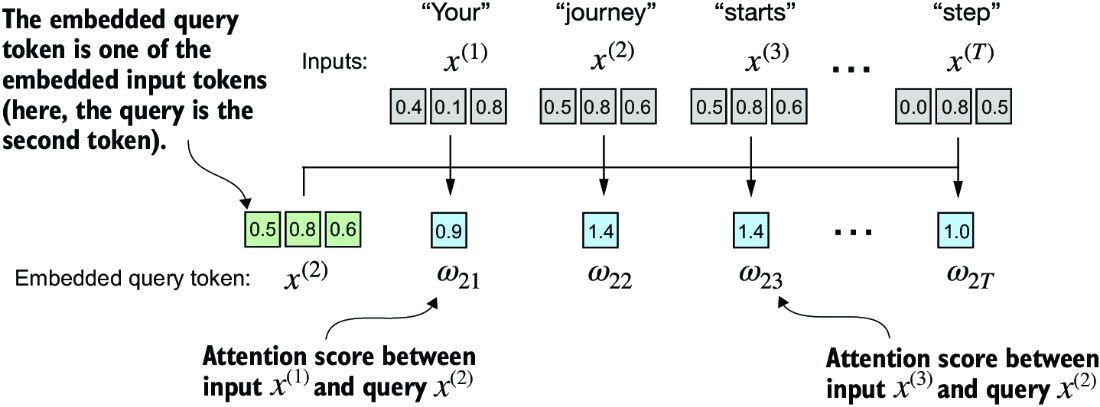
Visualizes attention scores as dot products between the second input query and every input element before normalization. section 3.3.1
