liveBook · Manning

Transformer block

As explained in Transformers in Action

A transformer block is a repeated computational unit in a transformer composed of attention and feed-forward components with neural-network connections and normalization.

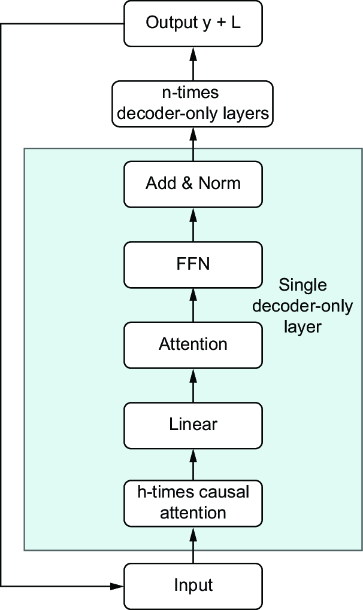
A transformer block is the repeated computational unit that forms a decoder-only model’s backbone. Each block combines attention, a feed-forward network, residual connections, and normalization; stacking blocks increases capacity and expressiveness while also affecting inference latency. section 3.2

Figure 3.1 Abstracted decoder-only architecture
figure

Use the architecture figure to relate one block to the sequential stack that constitutes a decoder-only model. section 3.2

How Transformers in Action covers it

How deep it goes
Defines a single block through attention, normalization, residual additions, and an expanded MLP, without deriving their internals.
Examples
Uses a simplified GPT-2-style block with TensorFlow operations and attention-state output.
What you can do after
Build a simplified transformer block and identify its residual computation stages in decoder-only inference.
How it connects
Connects attention, feed-forward networks, residual connections, normalization, autoregressive decoding, and KV caching.

Related concepts

This explainer was generated by Manning's knowledge graph from the text of Transformers in Action. The section links point to the parts of the book it draws on.