Density reachability connects observations through a sequence of neighborhood relationships in DBSCAN. A point y is directly reachable from x when y lies within ε of the core point x. This direction matters: core points can reach noncore points, but noncore points cannot reach others. section 2.5.2
DBSCAN uses reachability alongside density thresholds:
- Core points contain at least minPts observations within radius ε, including themselves, and form cluster building blocks. section 2.5.2
- Border or reachable points are noncore points that can be reached from core points. section 2.5.2
- Changing ε and minPts changes the density threshold and can alter the resulting connectivity. section 2.5.2
A multi-step connection
If X and Y are core points, a point Z outside X’s immediate neighborhood can still be reached from X through Y. The chain illustrates density-connected points. section 2.5.2
Figure 2.30 X and Y are the core points, and we can travel from X to Y. Though Z is not in the immediate neighborhood of X, we can still reach Z from X through Y. This is the core concept of density-connected points used in DBSCAN clustering.
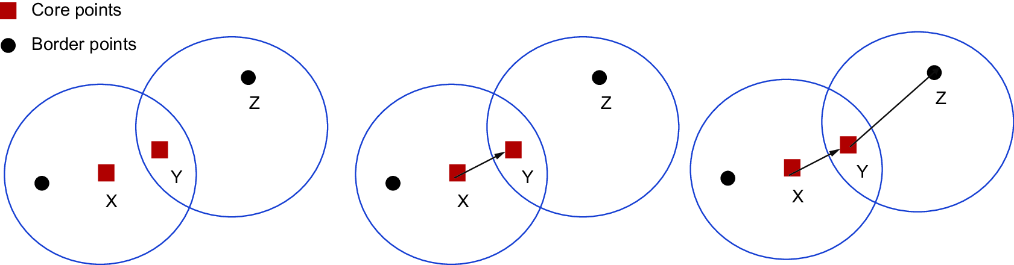
Trace the path from X to Y and onward to Z to see how DBSCAN connects points beyond a single neighborhood. section 2.5.2

