The React ecosystem is the collection of libraries and tools used around React to extend application functionality, improve performance, and support development workflows. Knowing React alone does not settle which tools belong in a project: the useful set depends on its requirements. section 1.4
A practical way to navigate the ecosystem is by the job a tool does:
- User interface: UI libraries and animation tools shape visual elements. section 1.4.1
- Architecture: data-management and authentication tools help structure application behavior. section 1.4.1
- Productivity: build tools and testing libraries support development and verification. section 1.4.1
Categories narrow the search, but they do not make tools interchangeable. Several UI libraries may achieve a similar result; build tools can differ in ways that matter to a project. Compare candidates against the requirements and the team’s familiarity with them rather than adopting every popular library. The resulting technology stack should give collaborators a shared blueprint across foundations, data management, APIs, UI, and testing. section 1.4.1 section 1.6
Figure 1.4 The React ecosystem is split into three main groups (UI, architecture, and productivity) and comprises hundreds of technologies, tools, and libraries. If you found the amount of technologies displayed in figure 1.1 daunting, this figure might break you.
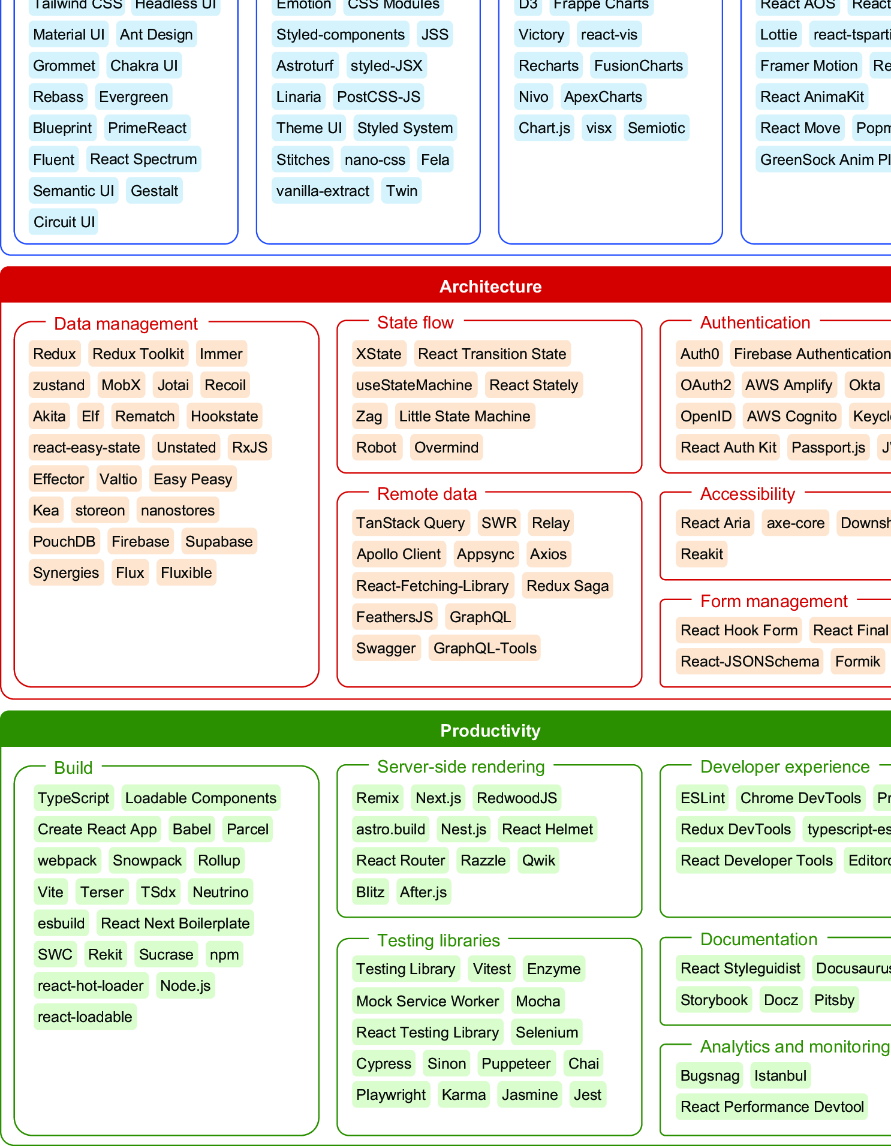
The ecosystem map shows the scale of the choice and locates tools within user-interface, architecture, and productivity groups. section 1.4.1
Ecosystem fluency builds on the ability to make simple React applications. The next challenge is choosing tools and practices that keep larger applications understandable, testable, maintainable, and workable across a team. Because tools and techniques keep changing, those choices need periodic reassessment. section 1.1 section 1.2
