A reactive application represents work as tasks with dependencies instead of making one thread wait through every I/O operation. Available threads can take on other tasks while a request waits. This approach suits some applications, but can complicate others; WebClient is recommended here only for reactive apps. section 11.4
Calculating a client’s total debt
A banking application may need to call several services to calculate a client’s total debt. In a reactive design, those steps become tasks with dependencies, rather than a single thread waiting at each service call. section 11.4
Figure 11.8 An analogy of the way a reactive app works. A thread doesn’t take a request’s tasks in order and wait when it’s blocked. Instead, all tasks from all requests are on a backlog. Any available thread can work on tasks from any request. This way, independent tasks can be solved in parallel, and the threads don’t stay idle.
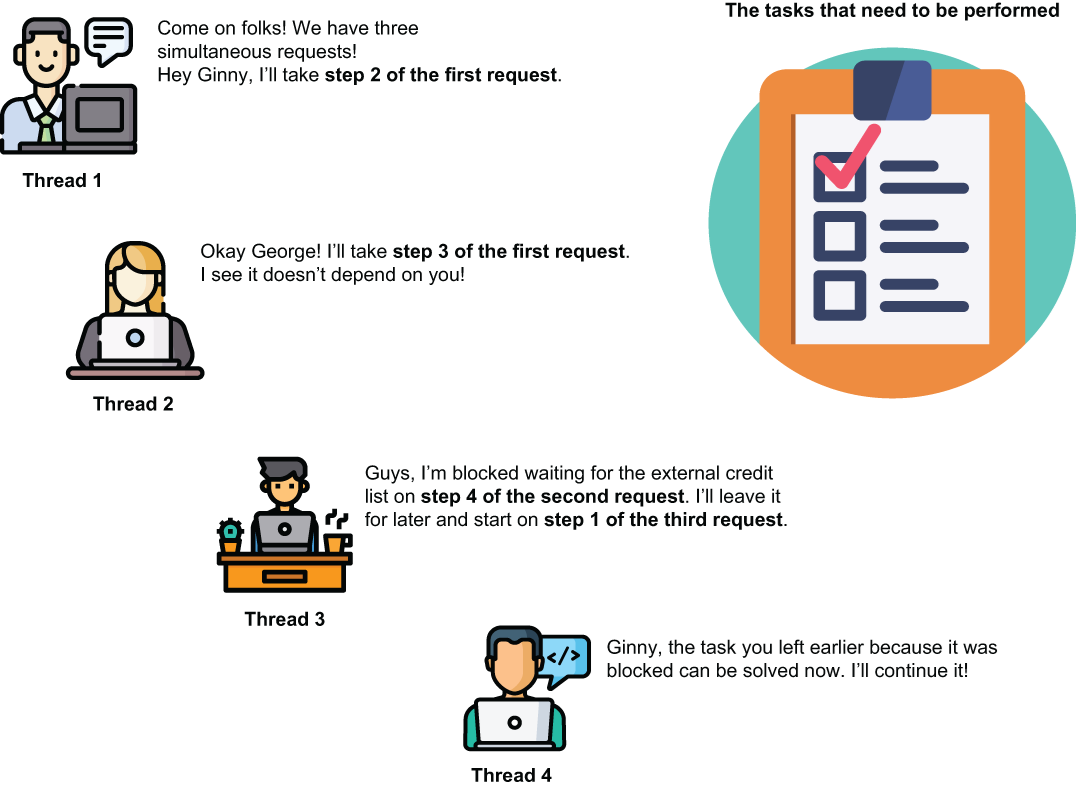
The diagram compares a thread waiting through one request with available threads picking up tasks from a shared backlog. section 11.4

