A reading pattern is a recurring way users visually scan page content. Research-based patterns help you group information and place important elements where users are likely to notice them. section 6.3.3
Use the pattern that fits the page content:
- The Z-pattern suits pages with minimal text. Users typically scan from left to right, move back down toward the left, and continue rightward, creating a Z-shaped path between key elements. section 6.3.3
- Treat reading patterns as guidance for positioning selected content, not as a complete page-layout system. section 6.6
Designing for language direction
If a website will support right-to-left or top-to-bottom languages, plan for different scanning directions at the start of the project. Adapting late can create layout rework and task churn. section 6.3.3
Figure 6.16 The Z-pattern is how a user typically scans a page: from left to right, and then back down to the left and right.
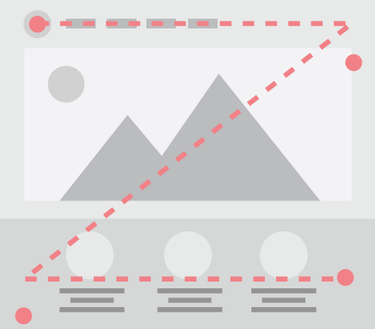
Use the diagram to visualize the Z-pattern as movement from left to right, back toward the left, and across again. section 6.3.3
