liveBook · Manning

Ready, fire, aim

As explained in The Art of AI Product Development

Ready, fire, aim is a fast development pattern that favors early implementation and learning through iteration over extensive upfront planning.

Ready, fire, aim is a fast development pattern: start with a prototype or MVP, learn from real use, and iterate instead of completing extensive upfront planning. section 2.3.2

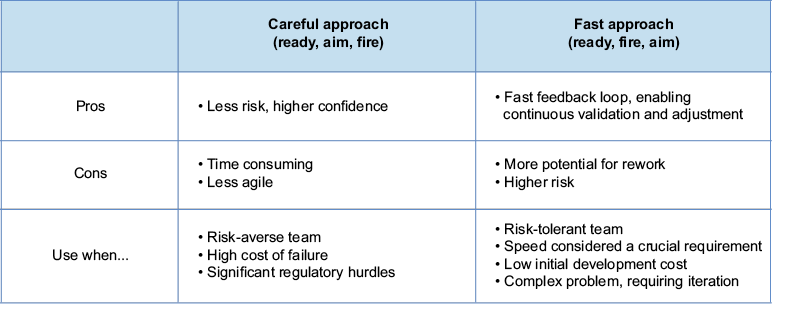
Figure 2.9 When to be careful versus fast: comparing the ready, aim, fire and ready, fire, aim approaches
A screenshot of a computer

AI-generated content may be incorrect.

Compare fast experimentation with the more careful ready, aim, fire approach across risk, speed, and adaptability. section 2.3

Use the pattern when:

  • A feasibility check shows limited upfront cost and the market rewards speed. section 2.3.2
  • The team can tolerate failing fast and learn through a limited deployment. section 2.3.2
  • Existing datasets, low-code/no-code tools, or prompt engineering can shorten the path to a working prototype. section 2.3.2
  • Avoid relying on it automatically for high-stakes work, where a careful, research-first approach may better manage risk. section 2.4

Personalized playlists

A team quickly prototypes playlists from a small segment of user data and releases the feature to a limited group. Feedback reveals that users want both familiar and novel songs, prompting an iteration that balances those preferences. section 2.3.2

How The Art of AI Product Development covers it

How deep it goes
Explains the pattern through trade-offs, selection criteria, and one iteration example, without detailing implementation internals.
Examples
Uses a personalized-playlist prototype that learns users prefer a balance of familiar and novel songs.
What it assumes
Assumes opportunity prioritization and feasibility checking, while teaching teams to test ideas through early user feedback.
What you can do after
Apply it via lean startup by building a limited prototype, gathering user feedback, and iterating against observed needs.
How it connects
Connects lean startup, minimum viable products, prototyping, user feedback, low-code/no-code tools, and prompt engineering.

This explainer was generated by Manning's knowledge graph from the text of The Art of AI Product Development. The section links point to the parts of the book it draws on.