A real amplitude is a quantum amplitude with no imaginary component. For a single-qubit state α|0⟩ + β|1⟩, where α and β are real, computational-basis measurement returns 0 with probability α² and 1 with probability β². section 4.1.1
The same rule extends to multiqubit states: each computational-basis outcome occurs with probability equal to the square of its corresponding real amplitude. Restricting examples to real amplitudes simplifies the treatment because complex amplitudes are deferred. section 4.1.1 section 2.7
Two-qubit measurement
For a state a₀|00⟩ + a₁|10⟩ + a₂|01⟩ + a₃|11⟩, measurement produces 00, 10, 01, or 11 with probabilities a₀², a₁², a₂², and a₃². A basis state such as |01⟩ produces 01 with certainty. section 4.1.1
Figure 4.2 Measuring two qubits in a superposition of all basis states can give any of the results 00, 01, 10, and 11, with probabilities equal to squares of the amplitudes of the corresponding basis states in the superposition state. When we measure a system that is in a specific basis state, we can only get the result that corresponds to that state, with 100% probability.
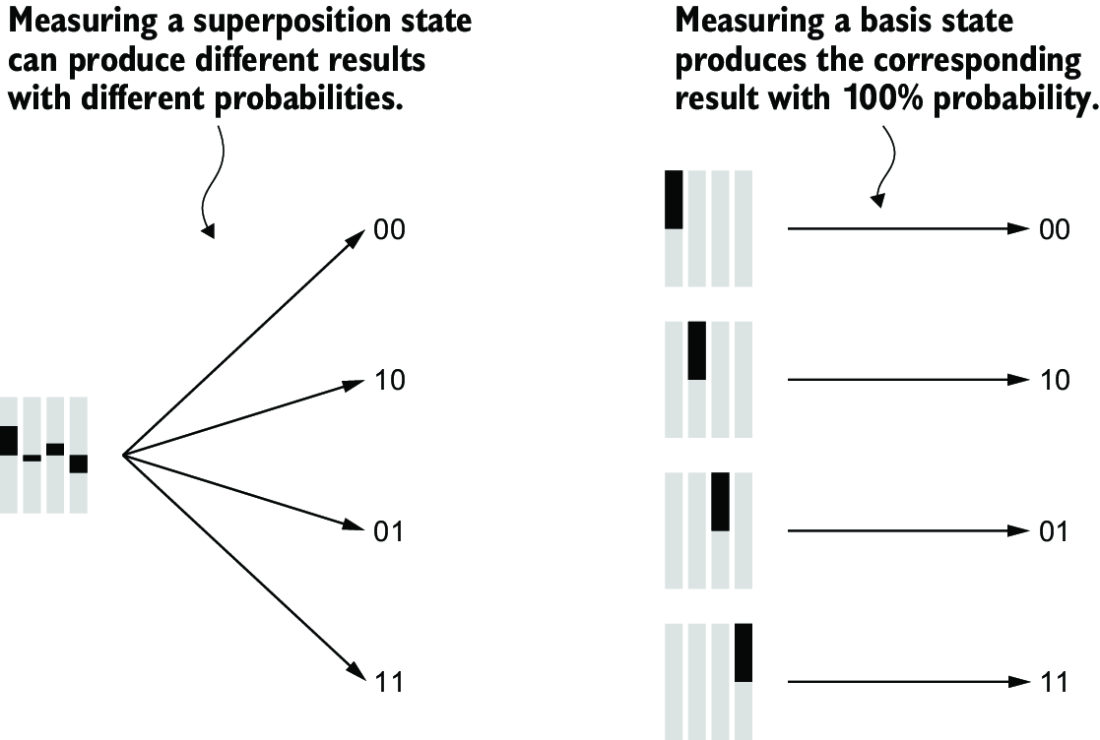
Use the figure to compare all two-qubit measurement outcomes with the squared amplitudes assigned to their basis states. section 4.1.1
Real-amplitude states also support simpler state-preparation exercises. Some structured states can be prepared more efficiently than arbitrary states, while general quantum algorithms usually require complex amplitudes. section 2.7
