Realistic data resembles the intended real-world data in its columns, values, and distributions. It helps prototypes behave like finished products before live data arrives. section 9.1.2
Shape test data around the conditions the final product will face:
- Choose believable columns, including dates, times, names, and addresses when relevant. section 9.1.2
- Constrain values to the expected setting, such as one country or future dates. section 9.1.2
- Match distributions, such as subscription prices or house prices clustered around a regional average. section 9.1.2
- Use a random generator or an LLM, then fine-tune the results instead of accepting convenient nonsense. section 9.1.2
A survey prototype
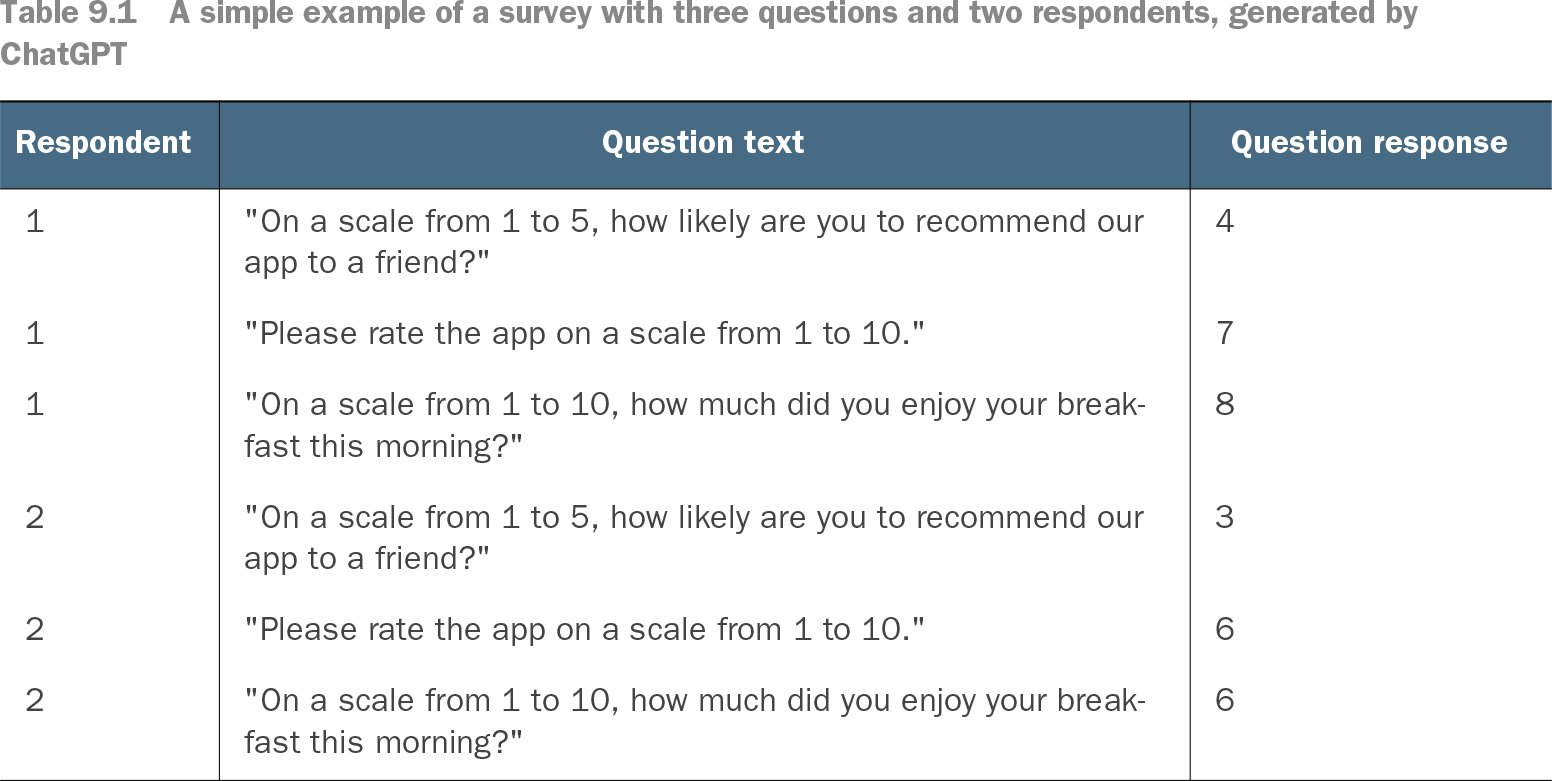
A generated survey dataset can preserve respondent rows, question text, and scaled responses. Two respondents answering three questions provide a small but structurally believable fixture for a prototype. section 9.1.2
Table 9.1 A simple example of a survey with three questions and two respondents, generated by ChatGPT (view table figure)
Browse a generated survey table showing question structure and responses for two respondents. section 9.1.2