The reasoning and planning layer controls how an agent thinks through a goal and sequences its actions. Structured reasoning is especially useful for long or branching tasks, tool-rich settings, costly errors, and situations requiring auditable decisions. Unlike model-native reasoning, structured patterns can be inspected, tested, and constrained. section 1.3.3
Choose a planning approach by weighing uncertainty against cost:
- Single-path planning commits to one sequence of steps. It is fast and cheap, but fragile when a step fails or results are surprising. section 1.3.3
- Multipath planning explores candidate strategies, evaluates them against the goal, and selects a promising branch. It can improve plans for hard tasks, at higher token and latency costs; tree-of-thought is one example. section 1.3.3
- An external planner, such as orchestration code or a workflow engine, sequences steps outside the executing agent and supplies its next step. section 1.3.3
When structured reasoning pays off
Consider tasks involving irreversible actions, such as sending emails, moving money, or modifying production data. Structured patterns make reasoning easier to inspect and constrain. section 1.3.3
Figure 1.9 Agent reasoning and planning, and how agentic thinking can be augmented. Reasoning can take many forms, from the underlying model that powers the agent to prompt engineering and the use of tools.
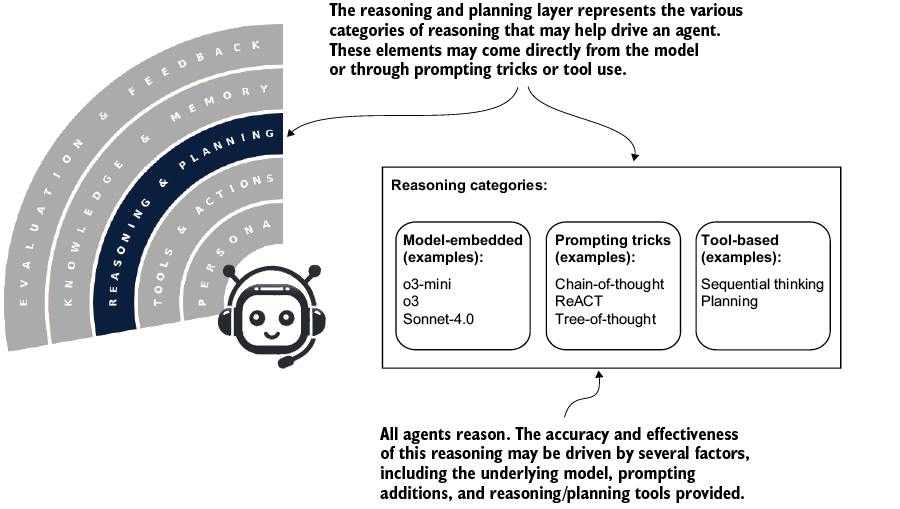
Use the diagram to see how reasoning and planning fit into the agent’s thinking process. section 1.3.3
