Reciprocal Rank Fusion (RRF) combines ranked result lists by ignoring raw scores and summing each result’s reciprocal rank offset. It is commonly used when hybrid search joins vector results with keyword results whose scores use incompatible scales. section 6.3.3
Use this mental model when merging search results:
- Run vector and keyword searches in parallel, producing one ranked list from each method. section 6.3.3
- Score each document with the sum of 1/(k + rank) across the lists, typically using k = 60. section 6.3.3
- Favor documents that appear near the top of both lists; a document ranked first in both receives the strongest fused position. section 6.3.3
- Avoid calibrating BM25, cosine-similarity, or other backend scores because RRF depends only on rank positions. section 6.3.3
Hybrid search for grounded answers
A query can be decomposed into semantic meaning and exact keywords. A hybrid search service runs both searches, applies RRF internally, and returns one reranked context. An agent can instead call vector and keyword tools separately, judge their relevance, and answer using the returned passages with exact references. section 6.3.3
Figure 6.7 The top of the figure shows how a user query could be converted to a hybrid search by decomposing the query into keywords and semantic meaning. The bottom of the figure shows how an agent could use the same search mechanism as a set of tools to perform a semantic (vector) and keyword query.
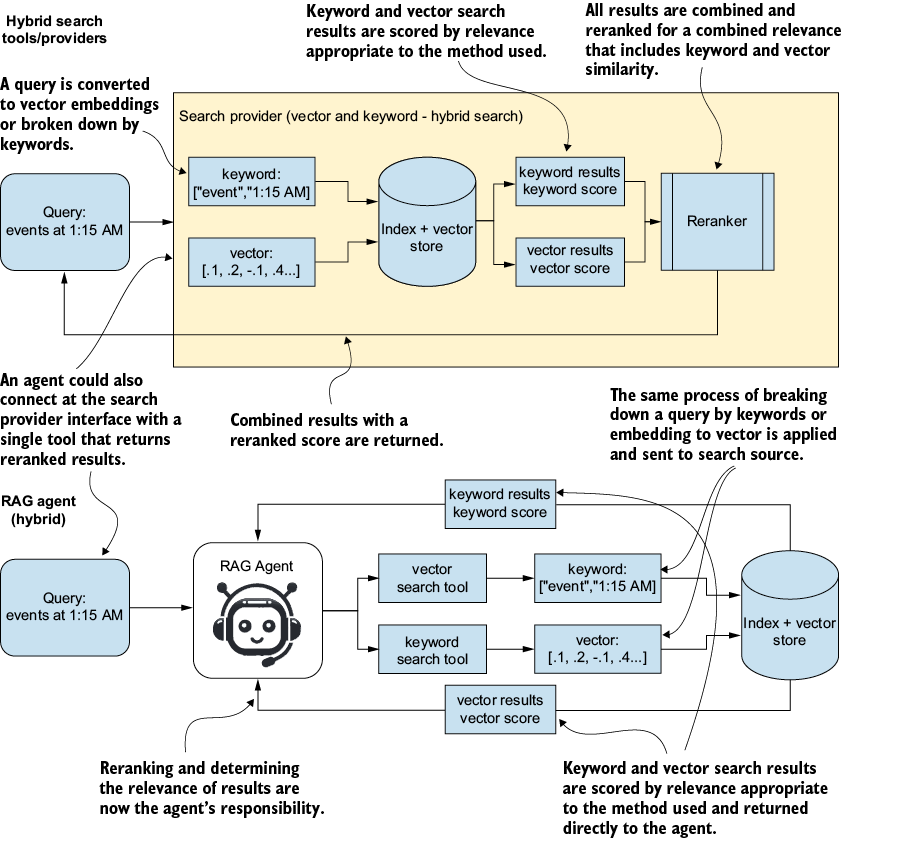
Compare service-managed hybrid search with an agent that invokes semantic and keyword searches as separate tools. section 6.3.3


