liveBook · Manning

Reconciled specification

As explained in Spec-Driven Development

A reconciled specification is a specification reconstructed from an existing application that accurately describes the system but does not govern its changes.

A reconciled specification describes an existing application faithfully, but has low control authority: the code remains the real source of change. It can inform future work without governing it. section 3.5.3

Brownfield application

When an application has no specifications, reverse-engineer its behavior into a specification. This can help an agent understand existing behavior and reason about impact, but does not make the specification the source of change. section 3.5.3

Figure 3.5 How alive a specification is depends on the control authority and fidelity.
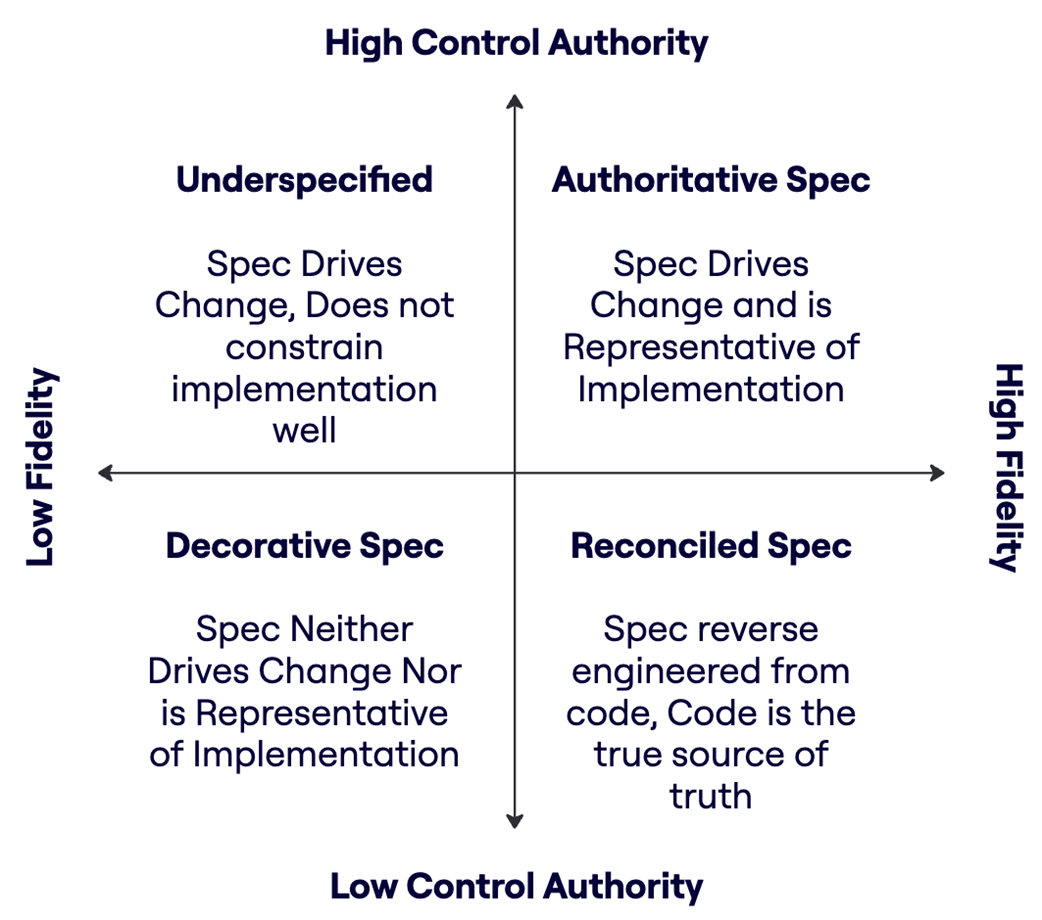
The matrix locates reconciled specifications by fidelity and control authority, alongside three other specification states. section 3.5.3

How Spec-Driven Development covers it

How deep it goes
Distinguishes fidelity from control authority and explains practical uses, without detailing a reverse-engineering procedure.
Examples
Uses a brownfield application whose behavior is reverse-engineered into a specification.
What you can do after
Evaluate whether a specification describes the application without governing its changes.
How it connects
Contrasts with authoritative, underspecified, and decorative specifications.

Related concepts

This explainer was generated by Manning's knowledge graph from the text of Spec-Driven Development. The section links point to the parts of the book it draws on.