A reconnaissance attack gathers information that can map a target’s attack surface before exploitation. Non-intrusive reconnaissance uses ordinary, low-impact interactions such as DNS lookups, HTTPS HEAD requests, and TLS handshakes; it sends no payload, vulnerability probe, or authentication attempt. Truly passive techniques instead rely only on third-party or public data and never contact the target. section 4.1 section 4.3.3 section 4.7
The key distinction is not whether traffic is quiet, but whether it reaches the target. A HEAD request or certificate inspection is often similar to normal browser or crawler traffic, yet remains a network action. Direct activity can be logged and requires explicit scope and authorization; scope must be enforced as a system constraint, with out-of-scope requests blocked and recorded. section 4.3.3 section 4.6 section 4.7
A repeatable reconnaissance pipeline separates discovery from interpretation and records durable evidence:
- Plan candidate hosts, then resolve DNS names to collect IP addresses and naming information. section 4.3.3 section 4.7
- Probe lightly with HTTPS HEAD requests; inspect response metadata and use header signatures only as a heuristic for possible WAF or CDN presence. section 4.3.3
- Optionally inspect TLS ALPN and SAN values or retrieve robots.txt and sitemap hints when deeper inspection is approved. section 4.3.3
- Sanitize sensitive header values before persistence, then write timestamped JSONL artifacts that preserve actions, observations, and context. section 4.3.3 section 4.7
Low-impact domain mapping
For a scoped root domain, generate candidate subdomains, resolve each name, send an HTTPS HEAD request to live hosts, and optionally inspect TLS metadata. Store the status, sanitized headers, notes, and timestamps as one append-only artifact per host. The resulting record supports later review without turning the workflow into vulnerability testing. section 4.3.3 section 4.7
Figure 4.1 Our passive reconnaissance pipeline. The pipeline gathers information about a target domain and its subdomains. For each discovered subdomain, the pipeline queries DNS servers to retrieve the IP addresses to which the subdomain points. The pipeline then sends an HTTP HEAD request to each live subdomain. If the subdomain uses HTTPS, the pipeline examines the TLS/SSL certificate, checks for Application Layer Protocol Negotiation (ALPN), and inspects the Subject Alternative Name (SAN). All this information gets written to JSONL.
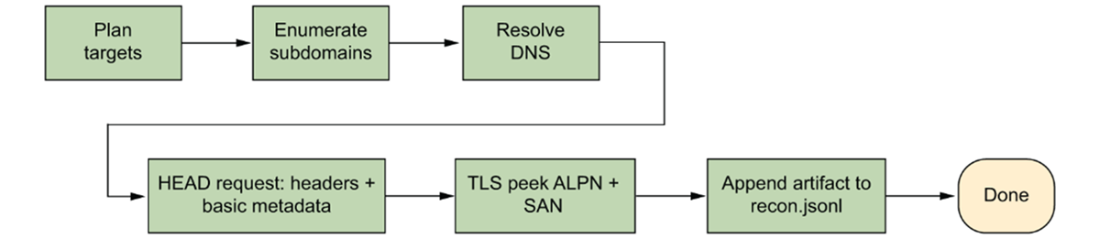
The pipeline view makes the boundary concrete: discovery feeds DNS resolution, lightweight HTTP and TLS observations, and JSONL persistence rather than payload delivery or authentication. section 4.1
An AI-assisted workflow should augment analyst judgment rather than act independently. Approval gates, time windows, least privilege, explainable suggestions, and human accountability make reconnaissance reviewable and safer; artifacts also let later analysis correlate weak signals across many assets. section 4.0 section 4.7 section 1.1


