liveBook · Manning

Recursive data structure

As explained in Elixir in Action, Third Edition

A recursive data structure is a structure whose elements or parts can contain structures of the same form.

A recursive data structure contains parts with the same form. In Elixir, a nonempty list is a pair: [head | tail], where tail is another list. section 2.4.4

The list representation makes several operational properties visible:

  • Reading the head or tail takes O(1), because each operation reads one part of the pair. section 2.4.4
  • Prepending is efficient; appending or concatenating traverses the left list and costs O(n). section 2.4.4
  • Pattern matching can bind the two parts directly with [head | tail]. section 3.1.5

Building a list from pairs

[1 | [2 | [3 | [4 | []]]]] produces [1, 2, 3, 4]. A practical match, [head | tail] = [1, 2, 3], binds head to 1 and tail to [2, 3]. section 2.4.4 section 3.1.5
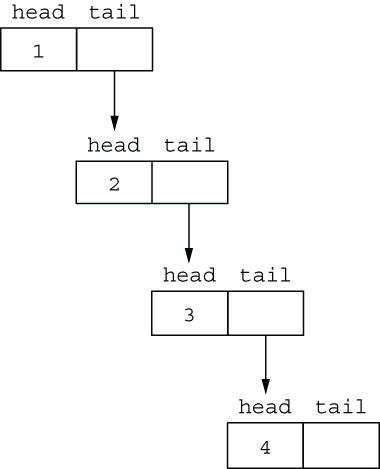
Figure 2.1 Recursive structure of the list [1, 2, 3, 4]
CH01_F02_Juric3

Use the list diagram to visualize how each tail points to the next head-tail pair. section 2.4.4


How Elixir in Action, Third Edition covers it

How deep it goes
Explains internal head-tail construction, constant-time access, linear updates, and improper-list boundaries.
Examples
Uses nested cons-style expressions, head-tail matches, list updates, concatenation, and a recursive list diagram.
What you can do after
Apply Elixir head-tail syntax to construct, decompose, and reason about list access and update costs.
How it connects
Connects lists with pattern matching, tuples, list operations, and recursive definitions.

Also explained in

Compare how 2 books explain recursive data structure →

Related concepts

This explainer was generated by Manning's knowledge graph from the text of Elixir in Action, Third Edition. The section links point to the parts of the book it draws on.